Zowee, I'm pretty sure several readers of this blog will be interested in signing on for this:
http://emergent-us.typepad.com/emergentus/2005/10/do_you_listen_t.html
G'wan, put your electronic John Hancock on that petition. The world needs more than one kind of Christian radio!
26 October 2005


24 October 2005
Overwhelmed by great theology and practice
Well, I just got back from six days in the Twin Cities with dear friends who also happen to be brilliant theologians and deeply spiritual people (and whose two-year-old son is a non-stop delight). And I was there to learn (at a conference at Luther Seminary) from some of North America's deepest thinkers in Missional Church theology, and I found out the amazing extent to which they're not just thinking, writing, and teaching but doing--helping congregations and church systems to transform themselves and discover and live out their missional vocation in the world. And I got to worship at Solomon's Porch, one of the most creative American Emerging Churches. And...I'm a bit overwhelmed. And incredibly grateful--to my friends, to these Missional Church theologian/sociologists, and to God.
Much more on this later. For the moment, I'm too tired and it's too late.
Peace, all!
Much more on this later. For the moment, I'm too tired and it's too late.
Peace, all!
17 October 2005
Where's the purple?
Grumble. I agree with the general thrust of this article by Noah Feldman in America's Number One Newspaper (and the one that happens to direct-deposit my paycheck), but several statements really annoyed me. For example:
Beginning of fourth paragraph, just below the heading, "The divide": "The country is split between two camps." Aren't we tired of that simplistic binary worldview yet? Well, some of us are, anyway.
End of the paragraph after that: "Tell me whether you think religion should play a role in government decisions, and I'll tell you where you come out on these core debates [i.e., abortion and end-of-life issues]." No, Noah, you won't. You and I could play that game (and you and many, many people I know could play that game), but if I were you I'd avoid betting money on it. Try rock-paper-scissors instead.
Here's a whole paragraph near the end:
"If we were serious about getting back to the Framers' way of doing things, we would adopt their two principles: no money and no coercion. This compromise would allow plenty of public religious symbolism, but it would also put an end to vouchers for religious schools. God could stay in the Pledge, but the faith-based initiative would be over, and state funds could reach religious charities only if they were separately incorporated to provide secular social services."
I actually think "no money, no coercion" is a pretty good guiding principle for these debates, but I'm not sure I agree with some of his conclusions. Is there really no coercion involved when a teacher stands up in front of a class of elementary school kids and says, "OK class, now we're all going to recite the Pledge of Allegiance together"? Also, what does this say about "In God we trust" on currency? It is money, so does it fall under "no money"? (Obviously it's a stretch if it does, since it arguably costs the same to mint coins with that slogan as it does coins with any other slogan on them.) Is it coercion because everybody who lives in this country has no choice but to use our money, even atheists and Buddhists? Or since using the money doesn't imply that you agree with the slogan printed on it, is that argument weightless? (If I use Canadian money does that mean I'm fond of HRH the Queen?) Hmm.
Right after that, he says, "The public could logically embrace this modest proposal, and the zealots on both sides should think it over." Hang on, you just spent the first part of the article implying that "the public" was made up more or less exclusively of "the zealots on both sides". You mean it's possible that real people are purple, not necessarily fire-engine red or royal blue?
One statement in the last papagraph is something we need to all come to terms with: "No longer Judeo-Christian (if we ever were), we are now Judeo-Christian-Muslim-Buddhist-Hindu-agnostic-atheist." Yeah, and -Sikh-Taoist-Confucianist-Ifa-NewAge-Scientologist-Jain-RollYourOwn-etc.-etc.-etc. We're simply not going to get where we're going by re-establishing Christendom and the so-called "Judeo-Christian society". I just don't think it's what we're called to do in this place and time. But I think what we are called to usher in--a Kingdom of God that welcomes all kinds of folks of all kinds of faiths--is way cooler anyway.
In any event, I thought it was an interesting article, even if parts of it torked me off a little. Apparently it's the beginning of a regular feature of writing on faith topics by my beloved employer, so I'll be keeping an interested eye on what they come up with.
Beginning of fourth paragraph, just below the heading, "The divide": "The country is split between two camps." Aren't we tired of that simplistic binary worldview yet? Well, some of us are, anyway.
End of the paragraph after that: "Tell me whether you think religion should play a role in government decisions, and I'll tell you where you come out on these core debates [i.e., abortion and end-of-life issues]." No, Noah, you won't. You and I could play that game (and you and many, many people I know could play that game), but if I were you I'd avoid betting money on it. Try rock-paper-scissors instead.
Here's a whole paragraph near the end:
"If we were serious about getting back to the Framers' way of doing things, we would adopt their two principles: no money and no coercion. This compromise would allow plenty of public religious symbolism, but it would also put an end to vouchers for religious schools. God could stay in the Pledge, but the faith-based initiative would be over, and state funds could reach religious charities only if they were separately incorporated to provide secular social services."
I actually think "no money, no coercion" is a pretty good guiding principle for these debates, but I'm not sure I agree with some of his conclusions. Is there really no coercion involved when a teacher stands up in front of a class of elementary school kids and says, "OK class, now we're all going to recite the Pledge of Allegiance together"? Also, what does this say about "In God we trust" on currency? It is money, so does it fall under "no money"? (Obviously it's a stretch if it does, since it arguably costs the same to mint coins with that slogan as it does coins with any other slogan on them.) Is it coercion because everybody who lives in this country has no choice but to use our money, even atheists and Buddhists? Or since using the money doesn't imply that you agree with the slogan printed on it, is that argument weightless? (If I use Canadian money does that mean I'm fond of HRH the Queen?) Hmm.
Right after that, he says, "The public could logically embrace this modest proposal, and the zealots on both sides should think it over." Hang on, you just spent the first part of the article implying that "the public" was made up more or less exclusively of "the zealots on both sides". You mean it's possible that real people are purple, not necessarily fire-engine red or royal blue?
One statement in the last papagraph is something we need to all come to terms with: "No longer Judeo-Christian (if we ever were), we are now Judeo-Christian-Muslim-Buddhist-Hindu-agnostic-atheist." Yeah, and -Sikh-Taoist-Confucianist-Ifa-NewAge-Scientologist-Jain-RollYourOwn-etc.-etc.-etc. We're simply not going to get where we're going by re-establishing Christendom and the so-called "Judeo-Christian society". I just don't think it's what we're called to do in this place and time. But I think what we are called to usher in--a Kingdom of God that welcomes all kinds of folks of all kinds of faiths--is way cooler anyway.
In any event, I thought it was an interesting article, even if parts of it torked me off a little. Apparently it's the beginning of a regular feature of writing on faith topics by my beloved employer, so I'll be keeping an interested eye on what they come up with.
15 October 2005
Buddha, Jesus, and me
 You know the woman Jesus met at the well in Samaria, who was flabbergasted because he seemed to know her life story? (If you don't know her, read the fourth chapter of the Gospel of John and get to know her. Go on, read your scripture. It's good for you.) Well, I felt a little like she must have felt when I read this post by Gallycat/Helen. It's not exactly how it happened in my life (ok, it's obviously allegorical for Helen as well, but you know what I mean), but damned if it doesn't resonate with my experience. That guy Buddha, he's pretty gracious like that, as are a surprising number of his followers. I'm pretty sure Jesus is too (and in this case I mean gracious in the everyday sense; I know he's gracious in the theological sense), though a lot of people are convinced he's more of a "my way or the highway--TO HELL!" sort of dude. Oh well, Gallycat, thanks for writing a piece of my story better than I could have done. (And in return, I stole your really cool GIF.) :-)
13 October 2005
Begin with the mission?
 So there's this really exciting idea that's been floating around certain Christian circles for the last 10 years or something (probably longer), called "Missional Church." Here's a really good FAQ on the concept (it's a PDF). If you don't feel like reading that, I'll summarize: a Missional Church is a community of Christians (of any size) who define their Christian identity primarily and fundamentally as that of a people on a mission. This mission is thought of as having been given to us by Jesus himself, and to consist of following in his footsteps, passing on his teachings, continuing and growing the community he formed, and doing the deeds he did. Put another way, our mission is to welcome the entire world to receive and enter into the Kingdom of God, God's New World that Jesus spoke constantly about and demonstrated through his actions.
Reactions to these ideas range from,"Well, duh!" to "What on earth are you talking about?" Which is only to be expected. But honestly, I think folks with the latter reaction are closer to the truth. I mean, if you honestly think that this is how most Christians of any persuasion have approached their faith down through the ages, I'd have to quibble with your assessment of history and current events. And I've come to believe that if Christians do come to see their faith in these terms, it can be revolutionary.
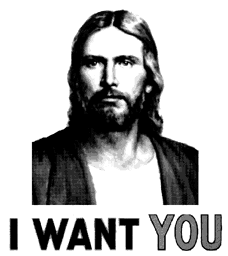
But I'm not writing to evangelize you about being missional. I'm writing to reflect on the implications of the missional idea for evangelism. I've never really thought that the classic evangelical presentation of the Gospel ("you are a sinner, the wages of sin is death, Jesus died so you could live, choose Jesus choose life") would be very effective with most people I know. But I'm really rather intrigued by the potential of the Christian equivalent of the old Uncle Sam poster: "Jesus wants YOU! He's got a mission for you: to help him usher in a New World."
Conventional Christian wisdom, it seems to me, would put any discussion of mission way, way at the tail end of any process of evangelism or disciple-making. First you "convert" someone, then you invite them into the community, then when they start to get committed, you approach them about serving within the community, then and only then you might start to talk to them about serving and transforming the world. Or, if you believe in "belonging before believing" (as I surely do), then you reverse the first two steps, but the rest probably proceeds as above. Membership, Maturity, Ministry, then Mission, to quote a four-step disciple formation system first pioneered at one of the innovative megachurches and now being adapted, with my wholehearted approval, at my own church. It's logical, right? But what if it's backwards? What if mission should (at least sometimes) come first?
I'm pretty convinced that there are lots of folks out there, particularly younger, postmodern, post-Christian folks, who want very much to make a difference in the world, to transform it a little, to make it a slightly better place. But they don't know where to begin. If they do find a way to help (for example, volunteering for an organization that's doing some good), often they don't stick with it for too long, because while they sincerely want to transform the world for the better, they themselves have not been transformed; they haven't encountered a tradition, a community, and a God with the power to transform them. And because of their background and experience (and this was me for many years), the idea that the church could be such a tradition and that the God of Christianity could be such a God seems really improbable.
But what if we began with the mission? What if our evangelistic icon weren't that classic chasm-with-us-on-the-left-and-God-on-the-right-and-the-cross-bridging-the-gap, but instead were that "Jesus wants YOU!" Uncle Sam poster? (Note for the metaphorically impaired: I don't mean really.) Would it cause folks to run away, or would it make them curious enough to try belonging and joining in the mission, in a context that could lead to both personal and local/global transformation?
I don't really know, but I wonder.
08 October 2005
Freakonomics
Holy crap, if you can read this article without your blood pressure rising at least once, you must be in a really unique place on the ideological spectrum. (Is there only one spectrum?) Still, I agree with Scot McKnight; it's the sort of thing that should be read and discussed.
07 October 2005
Minor gripe about the "kind and self-righteous"
I just wanted to bitch a bit about folks who are moved to charitable giving, but seem to feel that it's so incredibly magnanimous of them to want to give their money that the charitable organization they've chosen ought to bend over backwards to accommodate the manner in which they choose to give. I work with several organizations that help local homeless and low-income folks, and these donors that someone I know called "the kind and self-righteous" seem to be all too plentiful. It creates a huge amount of special work for organizations that want to make their donors happy, but aren't equipped to guarantee that certain monies go only to clients of a particular race, or that donors be billed not monthly or yearly, but on an irregular schedule, or that they be solicited once and only once per year.
So here's my cheeky advice for those who want to give. I don't care if you want to give $10 or $1M. If you want to help someone, find an organization that's helping and ask them how you can help. If their established ways of working don't suit you, then I suggest one of three options:
1) Look for another charity that suits you better,
2) Start your own aid organization, or
3) Get over yourself and just give as that organization is equipped to receive.
It's wonderful that you want to help others, but that doesn't make you a VIP. It makes you a real, blessed human being. Charity organizations are run on a shoestring, and they cannot make up new policies, procedures, and working models for every donor. Many of these organizations try to do that, but they shouldn't have to. In my opinion, donors have the right to expect exactly three things from the groups they donate to: that they be kept anonymous upon request, that they receive some form of thank-you, and that they get a receipt for tax purposes. Asking anything else is asking too much.
Anyway, that's my bitch for the evening. Take care.
So here's my cheeky advice for those who want to give. I don't care if you want to give $10 or $1M. If you want to help someone, find an organization that's helping and ask them how you can help. If their established ways of working don't suit you, then I suggest one of three options:
1) Look for another charity that suits you better,
2) Start your own aid organization, or
3) Get over yourself and just give as that organization is equipped to receive.
It's wonderful that you want to help others, but that doesn't make you a VIP. It makes you a real, blessed human being. Charity organizations are run on a shoestring, and they cannot make up new policies, procedures, and working models for every donor. Many of these organizations try to do that, but they shouldn't have to. In my opinion, donors have the right to expect exactly three things from the groups they donate to: that they be kept anonymous upon request, that they receive some form of thank-you, and that they get a receipt for tax purposes. Asking anything else is asking too much.
Anyway, that's my bitch for the evening. Take care.
Fellow disciples
 I just downloaded Picasa, and decided to try it out by uploading a picture taken last spring of members of my Discipleship Group. From left, it's Joanne, Susan, Janice, Anne, Patricia, Carl, Christine, and me.
06 October 2005
Walkabout
 I've blogged a couple of times about works by one of my favorite storytellers, Joss Whedon (Buffy, Serenity). Another one of my fave modern storytellers is J. Michael Straczynski, the mind behind Babylon 5 and, most recently, a bunch of really excellent comics. (Joss writes kick-ass comics too.) Anyway, I've been watching Babylon 5 again from the beginning, which is the only way to watch it. (If you've just seen one or two episodes, and concluded that it was just Deep Space Nine with silly hair, I encourage you to rent the DVD's starting from Season One--it's one of the biggest, richest sustained story arcs ever told in moving pictures, and the characters--ach, don't get me started.)
So in Season Three,one of the main characters, Dr. Stephen Franklin, experiences a major life crisis. He is made to realize that he's become addicted to stimulants, and he resigns as medical officer on the enormous space station and goes on "walkabout". (Franklin, by the way, is a Foundationist, a member of a faith that studies the cultures and faiths of humans and aliens, searching for spiritual truth.) Here's how he describes walkabout:
"You just leave everything and you start walking. The Foundation adopted the idea from the aborigines back on Earth. The theory is, if you are separated from yourself, you start walking and you kept walking, until you meet yourself. Then you sit down and you have a long talk. You talk about everything that you've learned and everything that you felt. You talk until you have run out of words. Now that is vital. 'Cause, the real important things can't be said. Then, if you are lucky, you look up and there is just you. Then you can go home."
On April 1st of next year (an auspicious day, to be sure), my wife Tina goes on walkabout. When she heard those words again the other night, she said, "Yep, that's what I'm doing." She's become separated from herself. So in less than seven months, she'll sling her pack on her back on Springer Mountain in Georgia, and won't stop walking until she reaches Katahdin Mountain in Maine, 2,175 miles and six months later. Or, until she meets herself.
I'll join her for stretches--a long weekend here, a week there. But I'm not cut out to walk for six months straight. So for most of those months, we'll be apart. I'll be lonely, and worried, and I'll miss her almost unbearably. But I understand. She's become separated from herself. I can tell that as well as she can. We've been married 12 years, together 16 years, and friends 20 years. I knew her when she was herself, and I miss her. So I'll miss her hard for 6 months in hope of meeting her again when she's done. It worked for Dr. Franklin, though he had to get himself stabbed in the gut and almost killed before it did. Er.
So I ask your prayers for both of us, but mainly for her. I figure if everybody I know starts praying seven months early, I'll be able to worry less. Maybe. A little. :-) And I'll be praying not just for her safety, but her success in finding what she's looking for. Amen.
03 October 2005
Cheap, useful laptops for kids in developing nations
Who needs broadband? Who needs bloated PC software? Who needs electricity?
According to MIT, not kids in developing nations (which is good, because they're unlikely to get those things soon). But what those kids do need is a way to connect with the wider world and "learn learning".
If this can be made to work, it's revolutionary. Check it out:
http://laptop.media.mit.edu/
According to MIT, not kids in developing nations (which is good, because they're unlikely to get those things soon). But what those kids do need is a way to connect with the wider world and "learn learning".
If this can be made to work, it's revolutionary. Check it out:
http://laptop.media.mit.edu/
You can't take the sky from me....
 OK, folks, I must say I'm a bit disappointed with the turnout for Serenity this weekend. Among current storytellers, Joss Whedon is easily in my top five (and probably in my top three) in the whole 'verse, and this is the first major motion picture over which he's had real creative control. And it kicks ass! Character, dialogue, action, humor, attractive actors, explosions, interesting thematic elements, humor, important questions raised (about freedom, belief, commitment, corruption), humor.... This is the guy who brought us Buffy and Angel. Everyone must see his movie.
Anyway, given the box office, I strongly suspect (much to my dismay) that not all six of my readers went and saw the movie this past weekend. It's OK. I forgive you. But see it this week! See it now! Ma shong, you bunch of gao yang jong duh goo yang!
OK, I'm better now.
Serenity,
Mike
28 September 2005
Another riff on the Lord's Prayer
I'm sick of all this philosophical mumbo-jumbo and reference to crap from my undergraduate comp-sci classes. This blog is getting to be way too much pretentious head and not enough heart. Sorry.
So instead, here's another take on the Lord's Prayer that I've been working and praying on for a few months. It started out as an attempt to train myself to be better at praying aloud spontaneously. Whenever I'm asked to lead prayer in a group, I get all tongue-tied and trip over myself trying to find the "right" words. So I decided to start with the Lord's Prayer (which I really think Jesus meant more as a model for prayer than a prayer to be literally repeated), and try to come up with a spontaneous personal expression of Christianity's most central prayer. I've done this sort of thing before.
Anyway, it started as an attempt to become more comfortable with allowing what was in my heart to come spontanously out of my mouth. Fairly quickly, it turned into an exercise in tinkering with and polishing the prayer until I thought the words were "right." This is just my personality and I might as well accept it. I still want to get better at praying aloud spontaneously. I think I just need to stop trying to make myself look small when someone says "Who wants to lead us in prayer?"
So here's the prayer I came up with. It comes from my heart via my head, and all credit goes to him who composed the original, of which this is just a heartfelt imitation.
Mike's prayer
Father God, we yearn with all our hearts for the coming of your Kingdom!
Mother God, we pray with all our hearts that we may play some part, as you've called, gifted, and sent us, in welcoming the entire world to receive and enter into your Reign.
In order that we may do this, we pray that you'll give us whatever we need today to best serve both You and our fellow creatures.
We pray that you'll free us from the anger, the guilt, and the other baggage we bring with us from our past.
We pray that you'll also free us from our fear of the future, and our own tendency to make a mess of it.
We ask all this in confidence, because we know that this Kingdom is real, and that it's Yours, and that You have the power to make it fully real on this earth.
And we pray in the name of your Son, Jesus.
Amen!
So instead, here's another take on the Lord's Prayer that I've been working and praying on for a few months. It started out as an attempt to train myself to be better at praying aloud spontaneously. Whenever I'm asked to lead prayer in a group, I get all tongue-tied and trip over myself trying to find the "right" words. So I decided to start with the Lord's Prayer (which I really think Jesus meant more as a model for prayer than a prayer to be literally repeated), and try to come up with a spontaneous personal expression of Christianity's most central prayer. I've done this sort of thing before.
Anyway, it started as an attempt to become more comfortable with allowing what was in my heart to come spontanously out of my mouth. Fairly quickly, it turned into an exercise in tinkering with and polishing the prayer until I thought the words were "right." This is just my personality and I might as well accept it. I still want to get better at praying aloud spontaneously. I think I just need to stop trying to make myself look small when someone says "Who wants to lead us in prayer?"
So here's the prayer I came up with. It comes from my heart via my head, and all credit goes to him who composed the original, of which this is just a heartfelt imitation.
Mike's prayer
Father God, we yearn with all our hearts for the coming of your Kingdom!
Mother God, we pray with all our hearts that we may play some part, as you've called, gifted, and sent us, in welcoming the entire world to receive and enter into your Reign.
In order that we may do this, we pray that you'll give us whatever we need today to best serve both You and our fellow creatures.
We pray that you'll free us from the anger, the guilt, and the other baggage we bring with us from our past.
We pray that you'll also free us from our fear of the future, and our own tendency to make a mess of it.
We ask all this in confidence, because we know that this Kingdom is real, and that it's Yours, and that You have the power to make it fully real on this earth.
And we pray in the name of your Son, Jesus.
Amen!
25 September 2005
And the obvious follow-up question...
...is: "OK, smart-ass, so you think faith is like a marriage. Then you must have some claim to knowledge (either present or future) that there's actually someone to be married to. On the question of God's existence, at least, isn't it a matter of fact or fiction, knowledge or lack thereof?"
Well...maybe. At the very real risk of producing a post that could only be understood by someone who's had college-level studies in both theology and computer science, it's true that faith is a little like being married to someone on the other side of a really good Turing Test. This is a proposed test for artificial intelligence: allow a human to freely question both a computer and another human. If the questioner can't tell which is which, then arguably the computer is truly intelligent. If the only way you could interact with your spouse were through the Turing Test interface, how would you ever know if the "person" you were married to were "real" or just an artificial, man-made construct? Similarly, it's possible I'll never know whether the God I have faith in is "real" or just a human invention. Never, even after death. It's possible that, after death, "I" won't have enough in common with the "I" of this earthly life for the question to be meaningful.
But as in the case of the possibly-silicon spouse: in the final analysis, what difference does it make? Apparently something attracted you sufficiently to the entity on the other side of that interface to make you fall in love and marry them. So enjoy your life and live your commitment!
Also, in the case of faith in God, Christians do have something that tips the balance on this question: Jesus Christ. How do we know the object of our faith is "real" and not "artificial"? Because he was real. He walked the earth, healed the sick, welcomed the outcast, loved the unloved, gave his life for his friends, and (so we believe) rose again to life. We know our God is not artificial because our God was a real, live human being.
So how, then, do we know that that human being was God?? Nyeesh, you are just full of questions, aren't you? Maybe some other time....
Well...maybe. At the very real risk of producing a post that could only be understood by someone who's had college-level studies in both theology and computer science, it's true that faith is a little like being married to someone on the other side of a really good Turing Test. This is a proposed test for artificial intelligence: allow a human to freely question both a computer and another human. If the questioner can't tell which is which, then arguably the computer is truly intelligent. If the only way you could interact with your spouse were through the Turing Test interface, how would you ever know if the "person" you were married to were "real" or just an artificial, man-made construct? Similarly, it's possible I'll never know whether the God I have faith in is "real" or just a human invention. Never, even after death. It's possible that, after death, "I" won't have enough in common with the "I" of this earthly life for the question to be meaningful.
But as in the case of the possibly-silicon spouse: in the final analysis, what difference does it make? Apparently something attracted you sufficiently to the entity on the other side of that interface to make you fall in love and marry them. So enjoy your life and live your commitment!
Also, in the case of faith in God, Christians do have something that tips the balance on this question: Jesus Christ. How do we know the object of our faith is "real" and not "artificial"? Because he was real. He walked the earth, healed the sick, welcomed the outcast, loved the unloved, gave his life for his friends, and (so we believe) rose again to life. We know our God is not artificial because our God was a real, live human being.
So how, then, do we know that that human being was God?? Nyeesh, you are just full of questions, aren't you? Maybe some other time....
More on faith and knowledge
 I don't have a whole lot of readers of this blog, but damn if they aren't of remarkably high quality.
My good friend Jayce from Rochester left the following comment on my post about faith and knowledge:
Anyway, you said, "All orthodoxy demands (in my opinion) is agnosticism tempered by an optimistic confidence in God" and went on to outline several logical combinations of alternatives. So the difference between faith and non-faith is how you read a tautology. By that, I mean that God revealing Himself to you (is that the right phrasing?) may or may not happen. Faith argues, "but it may" while non-faith argues, "but it may not." Given that this "revealing" is guaranteed to happen when you die (I'm making an assumption instead of asking just to speed up the comment-response cycle) then wouldn't that aspect of faith be a claim to knowledge you cannot possess?
Like Elizabeth M.'s comment on another post in the same series, this is an excellent question. So I thought that addressing it (as with Elizabeth's comment) merited its own post. So:
Where my meaning differs from Jayce's interpretation is in his assumption that my "optimistic confidence in God" refers to revelation leading, eventually, to intellectual understanding or knowledge. But note that in the same post on orthodoxy, just after the part Jayce quotes, I wrote: "Orthodoxy is just saying you don't know for sure that they aren't true, but that you accept them as part of your tradition and trust God to reveal their truth and meaning to you if and when it suits God's purposes to do so." (The emphasis on the word "if" wasn't in the originally post, but perhaps it should have been.) My point is: it may be that it's important to our ability to serve God and our fellow creatures that we come to an intellectual understanding of some of these items. If so, then I trust that God will lead me, at some point, to such an understanding. But it's by no means certain, in my mind, that my having such an understanding is important, and therefore I have no particular faith or assurance that I'll ever understand these things, even after death. Maybe, maybe not--and I'm OK with it either way.
So Jayce's tautology and its possible interpretations are interesting on an intellectual/logical level, but in my opinion (and I'm not trying to put Jayce down--he's a rather remarkable guy whose reasoning powers I highly respect) that's far from the most important level in spiritual matters. Faith is, in my opinion, primarily a matter of the heart, a matter of relationship and commitment, like a marriage. In a marriage, it's good to have an intellectual understanding of some aspects of your partner, but I gotta tell ya, there are some things you'll never understand. You just need to accept them--but that doesn't mean you've got to create artificial intellectual/logical constructs that simulate genuine understanding of those aspects. In fact, trying to do so will generally get you into a lot of trouble.
If your mindset is primarily quote-unquote "modern," you probably think that that all sounds like sidestepping the question. I hear ya. But for those of us in the postmodern world (which in some ways is like the premodern world), it's where we're at. The logical/rational/understanding/knowledge questions are important; I'm not denying it. But are they everything? Are they the the most important? Hmm. Don't know, and don't know if I'll ever know. :-)
17 September 2005
Emerging = evangelical?
I keep on hearing things in the news lately that threaten, with their combined weight, to break my heart. The problem--the crisis, really--is that described in the article linked in my last post. In brief: the world and this nation are groaning in poverty, injustice, and war. Jesus' heart would have broken--Jesus' heart does break. The Christian right, who believe in making faith part of public and political life (and do very effectively make faith a very big part of public and political life), somehow don't think those are God's priorities. The Christian left, for whom counteracting poverty, injustice, and war are (sometimes) priorities, don't believe in making faith a part of public and political life, and if they did, they'd be laughed off the stage as irrelevant. Because we are overwhelmingly a (professedly) Christian nation, I don't think it's possible to say that these problems will be solved in this country through secular means. One or another form of Christianity is going to heavily influence the public debate and limit the effectiveness of secular solutions.
Of course, secular organizations and a great many faith-based organizations are doing huge amounts of good, but what kills me is the vast reservoir of untapped resources that we could lay claim to if the two sides of the left-right gulf within Christianity could somehow be persuaded to stop fighting each other and get busy with the mission Jesus gave us. Lefties: news flash: we have a mission. We are expected to get our asses in gear. If you haven't found a community that is helping you see how your faith should be transforming you and the world, let me know; I'll help you look for one. Righties: news flash: the mission is not primarily about beating people over the head regarding personal morality issues. It's primarily about healing the world and its people and inviting them to join us in that adventure.
So, I'll call that Problem Number One.
In related news, people have been noticing for decades now that both the Christian left and right are mightily missing the point. They have been at a loss to see what a Christian identity and a Christian community could possibly have to do with them. And, they've had kids. So we have whole generations of folks 35 and under, especially in urban areas, who have zero connection to the Christian faith story. Some of them may have been half-heartedly connected with a Christian church in their childhood. Based on that slim connection, they may decide to give the church another try some day. Maybe not. Lots of younger folks, however, have zero exposure to Christianity apart from the media and some Christian folks they may know. (Note that I'm not primarily talking about folks brought up in a non-Christian faith, but folks brought up with no faith.)
Like as not, these Christians are of either the right-wing-check-your-brain-(and-heart?)-upon-entering-the-church variety, or else the left-wing-check-your-faith-upon-exiting-the-church variety. I myself knew lots of Christians growing up, but with the exception of my Grandfather (some day I'll blog about Papa, one of my chief role models), my impression of every one of them was one or the other of those stereotypes. No doubt this was a grossly unfair impression in many cases (in fact, I've since learned that it certainly was), but I can nonetheless understand why, for many of these younger folks, the idea of joining a church makes about as much sense for them personally as the idea of joining the circus. But a lot of these younger folks want very much to make a positive difference in the world, if only they knew where to begin, and who could help them find a way to do that.
I'll call that Problem Number Two.
In the face of these two problems, I must admit that I get a little worked up when I hear people say that the Emerging Church conversation is a phenomenon of evangelicals, for evangelicals, relevant only to evangelicals. Yes, it began among (primarily nondenominational and Baptist) evangelical Protestants. Yes, to this day most of the conversation's leading lights and rank-and-file folks hail from that background. And yes, many of the books I've been reading on the Emerging Church pretty much assume that their audience consists exclusively of evangelical Protestants. The thinking, I guess, is that since a core assumption of the Emerging Church is that Christians are on a mission from Jesus that should transform their lives and give them an active, outward-directed faith, and since that's not the sort of faith that is associated with liberal mainliners, liberal mainliners are probably not interested. (Also, a lot of emerging writing seems to be geared toward getting conservatives to consider the "generous" part of "generous orthodoxy", which many liberals already get.)
OK, I follow this line of thinking, but let's assume for the sake of argument that I'm right in saying that a large part of the business of the Emerging Church is to work on finding solutions to Problems One and Two. Further, let's say I'm right in claiming that the Emerging Church folks are having some success in that business.
So I ask you: What exactly about Problems One and Two makes them a bigger issue for evangelicals than for largely-liberal mainliners? My opinion: nothing. My own mainline church is one that gets, to a large extent, that faith should transform us and cause us to transform the world, but despite that, I see very few folks age 20 to 35 when I look around in our worship services. When I travel, I generally attend Episcopal or Lutheran churches, and guess what? I see the same thing there as well. Problem Two is not an evangelical, nondenominational problem. It's a Christian problem--and for all I know, it's probably a Hindu, Muslim, Jewish, and Buddhist problem as well. And Problem One is obviously equally "our" problem in the mainline--maybe more so, since both sides of the left/right squabble are well represented in our denominations and are very busy tearing them apart from the inside. So if the Emerging conversation is finding answers to these problems, how on earth can we sit back and say, "All of this sounds great! We're certainly glad some of you evangelicals are learning to be more generous! Keep us posted!"
Aaargh! No! We have to join this conversation. We've been invited, specifically, on multiple occasions, by multiple leaders in the Emerging Church--and by "we" I mean mainline Protestants, Roman Catholics, and Orthodox Christians alike. And I personally know many mainline individuals and congregations which are engaging this conversation. And for me, personally, these two problems are something that I feel very strongly called to help solve--perhaps to devote the rest of my life to helping solve. Tomorrow evening, several fellow disciples and I will gather at my church to talk about starting an Emerging-style service at Holy Comforter--a small step in this direction, or so I pray. God, if it's your will,be with us as we try to engage both emerging generations and our brothers and sisters from other parts of the Body of Christ in new ways. Amen.
Of course, secular organizations and a great many faith-based organizations are doing huge amounts of good, but what kills me is the vast reservoir of untapped resources that we could lay claim to if the two sides of the left-right gulf within Christianity could somehow be persuaded to stop fighting each other and get busy with the mission Jesus gave us. Lefties: news flash: we have a mission. We are expected to get our asses in gear. If you haven't found a community that is helping you see how your faith should be transforming you and the world, let me know; I'll help you look for one. Righties: news flash: the mission is not primarily about beating people over the head regarding personal morality issues. It's primarily about healing the world and its people and inviting them to join us in that adventure.
So, I'll call that Problem Number One.
In related news, people have been noticing for decades now that both the Christian left and right are mightily missing the point. They have been at a loss to see what a Christian identity and a Christian community could possibly have to do with them. And, they've had kids. So we have whole generations of folks 35 and under, especially in urban areas, who have zero connection to the Christian faith story. Some of them may have been half-heartedly connected with a Christian church in their childhood. Based on that slim connection, they may decide to give the church another try some day. Maybe not. Lots of younger folks, however, have zero exposure to Christianity apart from the media and some Christian folks they may know. (Note that I'm not primarily talking about folks brought up in a non-Christian faith, but folks brought up with no faith.)
Like as not, these Christians are of either the right-wing-check-your-brain-(and-heart?)-upon-entering-the-church variety, or else the left-wing-check-your-faith-upon-exiting-the-church variety. I myself knew lots of Christians growing up, but with the exception of my Grandfather (some day I'll blog about Papa, one of my chief role models), my impression of every one of them was one or the other of those stereotypes. No doubt this was a grossly unfair impression in many cases (in fact, I've since learned that it certainly was), but I can nonetheless understand why, for many of these younger folks, the idea of joining a church makes about as much sense for them personally as the idea of joining the circus. But a lot of these younger folks want very much to make a positive difference in the world, if only they knew where to begin, and who could help them find a way to do that.
I'll call that Problem Number Two.
In the face of these two problems, I must admit that I get a little worked up when I hear people say that the Emerging Church conversation is a phenomenon of evangelicals, for evangelicals, relevant only to evangelicals. Yes, it began among (primarily nondenominational and Baptist) evangelical Protestants. Yes, to this day most of the conversation's leading lights and rank-and-file folks hail from that background. And yes, many of the books I've been reading on the Emerging Church pretty much assume that their audience consists exclusively of evangelical Protestants. The thinking, I guess, is that since a core assumption of the Emerging Church is that Christians are on a mission from Jesus that should transform their lives and give them an active, outward-directed faith, and since that's not the sort of faith that is associated with liberal mainliners, liberal mainliners are probably not interested. (Also, a lot of emerging writing seems to be geared toward getting conservatives to consider the "generous" part of "generous orthodoxy", which many liberals already get.)
OK, I follow this line of thinking, but let's assume for the sake of argument that I'm right in saying that a large part of the business of the Emerging Church is to work on finding solutions to Problems One and Two. Further, let's say I'm right in claiming that the Emerging Church folks are having some success in that business.
So I ask you: What exactly about Problems One and Two makes them a bigger issue for evangelicals than for largely-liberal mainliners? My opinion: nothing. My own mainline church is one that gets, to a large extent, that faith should transform us and cause us to transform the world, but despite that, I see very few folks age 20 to 35 when I look around in our worship services. When I travel, I generally attend Episcopal or Lutheran churches, and guess what? I see the same thing there as well. Problem Two is not an evangelical, nondenominational problem. It's a Christian problem--and for all I know, it's probably a Hindu, Muslim, Jewish, and Buddhist problem as well. And Problem One is obviously equally "our" problem in the mainline--maybe more so, since both sides of the left/right squabble are well represented in our denominations and are very busy tearing them apart from the inside. So if the Emerging conversation is finding answers to these problems, how on earth can we sit back and say, "All of this sounds great! We're certainly glad some of you evangelicals are learning to be more generous! Keep us posted!"
Aaargh! No! We have to join this conversation. We've been invited, specifically, on multiple occasions, by multiple leaders in the Emerging Church--and by "we" I mean mainline Protestants, Roman Catholics, and Orthodox Christians alike. And I personally know many mainline individuals and congregations which are engaging this conversation. And for me, personally, these two problems are something that I feel very strongly called to help solve--perhaps to devote the rest of my life to helping solve. Tomorrow evening, several fellow disciples and I will gather at my church to talk about starting an Emerging-style service at Holy Comforter--a small step in this direction, or so I pray. God, if it's your will,be with us as we try to engage both emerging generations and our brothers and sisters from other parts of the Body of Christ in new ways. Amen.
15 September 2005
A Christian nation?
This article from Harper's Magazine, reprinted on Sojourners web site, is important reading, I think:
http://tinyurl.com/dc9vy
It's about our failures as a supposedly "Christian" nation where the face and voice of the Christian faith is often the Religious Right. What it doesn't cover (much) is the ways in which the Religious Left also misses the point, but it's gently provocative reading nonetheless.
UPDATE: here's the link to the article where it was originally published, on Harper's. If you don't feel like registering for Sojourners, read it here instead (no registration required):
http://www.harpers.org/ExcerptTheChristianParadox.html
http://tinyurl.com/dc9vy
It's about our failures as a supposedly "Christian" nation where the face and voice of the Christian faith is often the Religious Right. What it doesn't cover (much) is the ways in which the Religious Left also misses the point, but it's gently provocative reading nonetheless.
UPDATE: here's the link to the article where it was originally published, on Harper's. If you don't feel like registering for Sojourners, read it here instead (no registration required):
http://www.harpers.org/ExcerptTheChristianParadox.html
13 September 2005
Not really blogging
Sorry, folks, I didn't blog this weekend, because I was hanging out with a bunch of my closest friends. I think it's a good excuse. I will choose sleep over blogging now, too; in point of fact I don't feel too inspired at the moment. I helped out a little yesterday as my church loaded (and I mean loaded) a really big moving truck with supplies for a town in Mississippi. A staggering amount of goods, a staggering amount of effort on the part of some individuals that I am blessed to practice discipleship with, and it's just a cup of cool water in a desert of thirst. But still.
And I found out last night that someone I like and admire has breast cancer. I believe she has every chance of beating it, though.
Take care, all, and hold your loved ones close.
Peace,
Mike
And I found out last night that someone I like and admire has breast cancer. I believe she has every chance of beating it, though.
Take care, all, and hold your loved ones close.
Peace,
Mike
03 September 2005
Why orthodoxy? (Part 4: Why orthodoxy?)
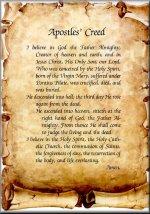 OK, I'm finally getting to where I wanted to go with this series, after far too much side trip, background, and disclaimer. So: If you're a Christian, why bother trying to be an orthodox Christian? Here are some reasons, in my opinion:
- The historic Christian belief system, for all the bad fruit it's borne down the centuries, has value. It's been the bedrock of the faith of a great many great souls in the nearly two millennia since it took form. St. Benedict of Nursia. St. Francis of Assisi. St. Patrick. St. Teresa of Avila. Dame Julian of Norwich. George Fox. Mother Teresa of Calcutta. Martin Luther King. Desmond Tutu. So many others. The creedal statements of orthodox Christianity are a way for you and me to stand together with these great souls in a single, unbroken tradition. It is good for that tradition to be whole and unbroken. It's a precious thing that shouldn't be cast off lightly, although it should naturally grow, evolve, and heal its own maladies, which admittedly are many. But that healing, I think, shouldn't result in breaking off from the essentials of that tradition. (What exactly are those essentials? That's a matter for honest discussion, but I would claim that the items listed in the first post in this series would be in that list.)
- All orthodoxy demands (in my opinion) is agnosticism tempered by an optimistic confidence in God. What I mean is: you don't have to say you know these things are true. Orthodoxy is just saying you don't know for sure that they aren't true, but that you accept them as part of your tradition and trust God to reveal their truth and meaning to you if and when it suits God's purposes to do so. The alternatives are to either say you know with certainty that these items are true, you know with certainty that they are false, or you couldn't care less. The first two alternatives to orthodoxy, it seems to me, are completely at odds with both faith and reason. The last is only at odds with faith.
- Orthodoxy gets you a seat at the table with conservative sisters and brothers in Christ. This may seem cynical, but it's not, and I think it's vitally important. I am not saying,"Lie to the conservatives about what you believe so they'll talk to you." However, if you can honestly say that you can affirm the basic tenets of the historic Christian faith, then you may be recognized as a brother or sister in the faith by those for whom orthodoxy is a fundamental requirement. If you must deny some of those tenets, you may be considered an outsider and not welcomed to the table. And in my opinion, being welcomed to that table is vital to healing the jagged divisions in the body of Christ that cripple us and hinder our mission. It's vital to enabling the mutual love by which Jesus said his followers would be recognized. Again, I'm not advocating dishonesty. I'm just saying that it's worth considering whether your discomfort with some of those tenets is close enough to negative certainty to preclude the trusting agnosticism mentioned above. To thine own self be true, but are you honestly that certain? Certain enough to trump Christian love?
So that's my case. I really don't think it's going to convince anyone, but if it's food for thought, that's all I hope for. I'm very hopeful that we, the body of Christ, might to some substantial degree heal our bitter left/right divisions and meet on the common ground of generous orthodoxy. So many of my evangelical and post-evangelical brothers and sisters are working hard to convince their fellow evangelicals, for whom orthodoxy seems self-evident, to be generous too. I feel compelled to do my part (as a mainline post-liberal) to try to help my fellow liberals, for whom generosity seems self-evident, to reconsider orthodoxy if they have dismissed it in the past.
So that's my first fumbling attempt. Sorry it took so long. In my wildest prayers, I see us in the left hand and our friends in the right hand working toward a future in which we're both clasped at the heart of the Body of Christ. And I rejoice, though I also see that there is so much work that God has given us to do. God, be with us. Amen.
01 September 2005
Responding to Hurricane Katrina

ERD Responds to Hurricane Katrina
8/29/2005
[Episcopal Relief and Development]
As Hurricane Katrina leaves behind devastation in Florida and Louisiana, and closes in on Mississippi, Alabama, and Tennessee, Episcopal Relief and Development has mobilized in support of communities affected by this disaster.
After tearing through Florida on Friday, the Category 4 hurricane regained force over the Gulf of Mexico, with winds topping 145 mph.
This morning, Katrina touched down again, just east of New Orleans, Louisiana. Hurricane-force winds caused a path of destruction 250 miles across. A million New Orleans residents avoided harm by obeying a mandatory citywide evacuation.
Seventy percent of the coastal city is below sea level, and is protected from flooding by levees and pumps. After pumps failed in the Lower 9th Ward of New Orleans, filling the streets with six feet of water, dozens of people had to be rescued from the roofs of their houses.
Katrina is over Mississippi this afternoon. Storm surges in Gulfport, Mississippi have already plunged the city under ten feet of water. Winds tore the roofs off buildings in Biloxi, Mississippi.
Disaster officials will begin assessing the damage to Louisiana and Mississippi today.
Hurricane Katrina is one of the most destructive hurricanes ever to hit the US. Experts estimate that it could cause between $10 and $25 billion worth of damage. If the higher assessments are confirmed, Katrina will be the most expensive hurricane in US history.
On behalf of Episcopalians, ERD has sent emergency funds immediately to the Diocese of Mississippi. This emergency assistance will help vulnerable people whose homes are destroyed or severely damaged. ERD support will help the diocese provide aid to community members through two mobile response trailers, which are equipped with supplies like chainsaws and generators to assist in the recovery.
We are waiting to hear what kind of aid is most needed in Louisiana. We have also offered emergency assistance to dioceses likely to be affected as the storm moves inland, including Alabama and Tennessee. Forecasters also warn of the risk of high winds, flooding, and scattered tornadoes in Louisiana, Mississippi, Alabama, and Florida.
We offer our prayers for the people affected by this disaster--those whose homes are under 10 feet of water, those who have lost family members, and those whose businesses have been blown down and swept away. Please join us in praying for people affected by Hurricane Katrina.
To make a contribution to help people affected by Hurricane Katrina, please donate to the US Hurricane Fund by credit card via this page or by calling 1-800-334-7626, ext. 5129. Gifts can be mailed to: Episcopal Relief and Development, c/o US Hurricane Fund, PO Box 12043, Newark, NJ 07101.
Episcopal Relief and Development, an independent 501(c) 3 organization, saves lives and builds hope in communities around the world. We provide emergency assistance in times of crisis and rebuild after disasters. We enable people to climb out of poverty by offering long-term solutions in the areas of food security and health care, including HIV/AIDS and malaria.
I'm including the following Technorati tags 'cause TTLB told me to: flood aid and Hurricane Katrina.
Subscribe to:
Posts (Atom)