I need to make another disclaimer about what I'm not doing with this series of posts: I'm not doing what is usually thought of these days when you hear the word "evangelism": trying to make the Christian faith attractive to non-Christians. I am trying to do what has been referred to as "the continuing conversion of the church"; I'm asking those who consider themselves committed Christians--but who may not see the value of trying to affirm the core beliefs of Christianity--to reconsider that value. Although non-Christians are certainly welcome in the conversation, I'm not trying to say to them, "See how kewl Christianity is: we've got this big list of beliefs and fun and weaselly ways to believe them." That would be dumb. I think non-Christians are much more likely to come to the faith though the doors of community, practice, and "faith in", as opposed to "belief that." If arguing about beliefs ever really worked as a method of evangelism (doubtful), then that time is past, I think.
That said, I sincerely hope that non-Christians don't look at that list of beliefs a couple of posts back and see it as a big ol' wall they'd need to scale before they'd be welcome to try experiencing a Christian community. The sorts of Christian communities I hang out in will never, ever ask you if you affirm those beliefs. Your faith is between you and God. "Orthodoxy" never needs to be an issue for you unless you want it to be.
However, if you do consider yourself a Christian, but question (as well you might) the value of even trying to hold some of those beliefs in your head, this series of posts is intended to invite you and me to consider carefully that very good question.
27 August 2005


Why orthodoxy? (Part 2: Belief without knowledge??)
Elizabeth M. posted a comment on my last post which is so penetrating and such a good question that I felt it deserved its own post, for those who don't read blog comments. Here it is:
Mike's blog: "I don't think we need to claim that we know or understand the nature of the resurrection, or of the Holy Spirit, or the sense in which Jesus' mother is called the Virgin Mary."
Elizabeth: What does it mean to "affirm a belief" in the absence of knowledge or understanding? For instance, what would it mean to say that I believe Jesus was born of a virgin, but I don't know how that could be possible and in fact don't believe it is possible in any conventional sense? Wouldn't I be saying that I in some sense "know" Jesus was born of a virgin, while simultaneously admitting there is no way for me to "know" any such thing? By this way of thinking, what would then prevent me from affirming a belief in just any old thing: the noodly spaghetti lord, the blue dogs of the moon, the existence of invisible pink unicorns?
This is really a smashingly good question, and it gets down to a deeper question: "What is belief?" (Before I tackle that one, though, I should probably make a disclaimer that I should have made before: for me personally, belief takes a back seat in importance to two other things: faith and practice. By "faith" I mean "faith in someone" as opposed to "faith that something is true." The emphasis on practice is a very Anglican thing. But anyway, at the moment we're discussing belief, as in "belief that a proposition is in some sense true"....)
So, regarding the nature of belief, I have to admit that I'm strongly convinced that belief has much more to do with choice than is has to do with knowledge. Therefore (and I think this is true empirically), nothing is to prevent anyone from affirming a belief in the Flying Spaghetti Monster or the ever-popular Invisible Pink Unicorns--if they decide to believe in those things. I may tell myself that I have "become convinced" of some belief, that I have come to an understanding of it and it fits within my little monkey brain and my monkey brain has rationally judged it true in the same way that scientists construct hypotheses that become theories based on evidence. Many people believe (there's that word again) that this is the process they go through when they come to a belief in the resurrection, or the Trinity, or the divine/human dual nature of Jesus, or karma, or reincarnation, or the divine dictation of the Quran, or whatever. My personal opinion, however, is that they are full of shit. They chose to believe in those things, pure and simple. Evidence, understanding, and something like "knowledge" may play a role, but anybody who claims that something like the doctrine of the Trinity is some "knowledge" that he holds neatly in his head is fooling himself. If you believe in the Trinity, I promise you that it's not because you "understand" it. If you believe that Jesus was fully human and also fully divine, you're embracing a paradox--kind of like believing that it's somehow true to say that Jesus was born of a Virgin while also admitting that you can't understand how in any conventional sense this could be so.
Despite all that, one can choose to believe these things--or to believe in karma, reincarnation, Flying Spaghetti Monster, James Van Praagh, all of the above, whatever. There's a phrase that the modern world might apply to choosing to claim "belief" in something while admitting a lack of understanding of it: "intellectual dishonesty". I admit there's some truth in that charge. At the very least, there are some mental gymnastics involved in "believing" like this. But I contend that it's at least less dishonest to choose belief and admit lack of knowledge than it is to choose belief and claim knowledge you ain't got. But we're left once again with the question: why choose belief? Why orthodoxy? Why not skip the mental gymnastics and go for maximum intellectual honesty--which is probably a thoroughgoing skepticism? Tune in next time....
Mike's blog: "I don't think we need to claim that we know or understand the nature of the resurrection, or of the Holy Spirit, or the sense in which Jesus' mother is called the Virgin Mary."
Elizabeth: What does it mean to "affirm a belief" in the absence of knowledge or understanding? For instance, what would it mean to say that I believe Jesus was born of a virgin, but I don't know how that could be possible and in fact don't believe it is possible in any conventional sense? Wouldn't I be saying that I in some sense "know" Jesus was born of a virgin, while simultaneously admitting there is no way for me to "know" any such thing? By this way of thinking, what would then prevent me from affirming a belief in just any old thing: the noodly spaghetti lord, the blue dogs of the moon, the existence of invisible pink unicorns?
This is really a smashingly good question, and it gets down to a deeper question: "What is belief?" (Before I tackle that one, though, I should probably make a disclaimer that I should have made before: for me personally, belief takes a back seat in importance to two other things: faith and practice. By "faith" I mean "faith in someone" as opposed to "faith that something is true." The emphasis on practice is a very Anglican thing. But anyway, at the moment we're discussing belief, as in "belief that a proposition is in some sense true"....)
So, regarding the nature of belief, I have to admit that I'm strongly convinced that belief has much more to do with choice than is has to do with knowledge. Therefore (and I think this is true empirically), nothing is to prevent anyone from affirming a belief in the Flying Spaghetti Monster or the ever-popular Invisible Pink Unicorns--if they decide to believe in those things. I may tell myself that I have "become convinced" of some belief, that I have come to an understanding of it and it fits within my little monkey brain and my monkey brain has rationally judged it true in the same way that scientists construct hypotheses that become theories based on evidence. Many people believe (there's that word again) that this is the process they go through when they come to a belief in the resurrection, or the Trinity, or the divine/human dual nature of Jesus, or karma, or reincarnation, or the divine dictation of the Quran, or whatever. My personal opinion, however, is that they are full of shit. They chose to believe in those things, pure and simple. Evidence, understanding, and something like "knowledge" may play a role, but anybody who claims that something like the doctrine of the Trinity is some "knowledge" that he holds neatly in his head is fooling himself. If you believe in the Trinity, I promise you that it's not because you "understand" it. If you believe that Jesus was fully human and also fully divine, you're embracing a paradox--kind of like believing that it's somehow true to say that Jesus was born of a Virgin while also admitting that you can't understand how in any conventional sense this could be so.
Despite all that, one can choose to believe these things--or to believe in karma, reincarnation, Flying Spaghetti Monster, James Van Praagh, all of the above, whatever. There's a phrase that the modern world might apply to choosing to claim "belief" in something while admitting a lack of understanding of it: "intellectual dishonesty". I admit there's some truth in that charge. At the very least, there are some mental gymnastics involved in "believing" like this. But I contend that it's at least less dishonest to choose belief and admit lack of knowledge than it is to choose belief and claim knowledge you ain't got. But we're left once again with the question: why choose belief? Why orthodoxy? Why not skip the mental gymnastics and go for maximum intellectual honesty--which is probably a thoroughgoing skepticism? Tune in next time....
26 August 2005
Why orthodoxy? (Part 1)
 There's been a lot of talk in certain church circles lately about something called "Generous Orthodoxy". If you're not familiar with the term, take the time to Google it and check out the top five or so hits. In a nutshell, it's a term that means intentionally situating yourself within the spectrum of beliefs of the historic Christian faith (Orthodoxy) while at the same time building bridges, not walls, between yourself and those who differ from you (Generous). For me and for many whom I know (though by no means for all Christians or all humans in general), the "generous" part seems obvious. Bridges are better that walls, well sure, peace out, brother! (I'm poking mild fun as us hippies, but rest assured I am one.) Orthodoxy, on the other hand, is not necessarily of such obvious benefit. What's wrong with just doing your own thing? Orthodox, shmorthodox, it's all between the individual and God, right?
It's this point of view that I wanted to consider a little bit. I have sympathy for it, no doubt. But I think it creates some problems that are worth considering.
First of all, I'll take a stab at loosely defining "Christian orthodoxy". That's a bold thing to attempt to do, no? And make no mistake, many Christians would differ vociferously with the following definition. But here, for the record, is what Mike Croghan thinks defines an orthodox Christian.
An orthodox Christian believes that:
- The Trinity is a valid model for understanding the nature of God.
- God the Father or Creator was and is intimately involved in the creation of the universe and everything in it, seen and unseen.
- Jesus of Nazareth was and is God made manifest on earth, God's Son in a unique way, in complete union with the father.
- He was the the earthly son of the Virgin Mary and born through the power of the Holy Spirit. (I don't think we need to believe that we know exactly how this went down.)
- He really lived, was really killed, and in some sense really was resurrected and is alive now.
- The "Kingdom of God" that he inaugurated while he walked the earth will come to full fruition of earth and will have no end. When this happens, all of us, alive or dead, will experience something like Jesus' resurrection--whatever the nature of that might have been!
- The Holy Spirit is the real presence of God within everyone from the ancient prophets to the individual believer today.
- The Church in its broadest and best sense is a divine, holy, inclusive, and welcoming institution. The two main sacraments of baptism and communion are also divine in origin.
- The writings of the Bible were inspired by the Holy Spirit, meaning that the Spirit was intimately involved in their composition, and they are all profitable for teaching, etc. I don't think we have to believe that the Bible is inerrant or infallible, nor that what the Spirit wants to teach us in a passage is necessarily the literal, uncritical meaning of that passage.
I think that's about it. If you can affirm each of those points in some way, shape, or form, then I think anyone who claims you're not an orthodox Christian is being extremely unGenerous. I also think there's a lot of room for mystery within every one of those points. I don't think we need to claim that we know or understand the nature of the resurrection, or of the Holy Spirit, or the sense in which Jesus' mother is called the Virgin Mary. We don't need to claim that we know what the Spirit is saying through a difficult passage of Scripture. It is enough, I claim, to affirm that these words point to realities that we believe are indeed Real, and authentic, and fully part of our personal faith, and that these are realities we want to get to know better. That, I claim, is enough for orthodoxy.
But why bother? Why affirm these things--why make an effort to be orthodox? Why not just believe whatever comes easy to us and whatever makes perfect sense to us right now? I'll try to tackle that question in the next post in this series.
Touched by His Noodly Appendage
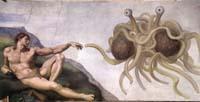 You know, I tend to talk an awful lot about Jesus in this blog. It's true that I'm pretty hung up on the guy, but in the interest of equal time, I feel I'd be remiss if I didn't make a passing reference to the Flying Spaghetti Monster. He may not quite be my kind of deity, but he has every bit as much of a place in the science classroom as does Biblical creationism (or some watered-down version of it called Intelligent Design "Theory"). Some day soon, in the name of giving kids all the "facts" and letting them make up their own minds, high school science students will have the opportunity to choose between Judeo-Christian theism, FSM Pastafarianism, and, well, just learning actual science. That is, if there's still time to learn science in between all the vague, neutered Biblical exegesis and the dressing up like pirates to learn about His Divine Noodliness. And don't forget the Norse point of view.
But hey, how are kids going to make informed choices if we don't give them all the information? And Flying Spaghetti Monster is relevant to other subjects too. (Math--who created all those numbers? English--whose meatballs rumbled with the first syllables of language? Home Ec--well, it's obvious.) So He should be part of the curriculum in every subject. Then, and only then, will students have all the facts. And every moment of their public school education will be an opportunity to by Touched by His Noodly Appendage. I just hope that the same thing is happening in other countries, or we may find ourselves in a spot of trouble a few years from now....
25 August 2005
No more Amazon Associate "ads"
Well, I got fed up with Amazon rotating in ads for things I *don't* recommend. So the Amazon book, DVD, and CD ads are gone. Maybe I'll replace them with plain old images-and-links some time.
20 August 2005
Opening doors?
 Well, there’s lots going on in my ministry life right now. I hesitate to write too much about it here, because much is in flux and I don’t want to prejudge outcomes. In the last post I shared some of my thoughts regarding my church’s renewed focus on evangelism. Another Big Deal in my life is that my rector, Fr. Rick, is interested in working (with a small team that’s beginning to form, including me) on what we hesitate to call an “alternative worship service”, but which will be along the lines of Emerging Church gatherings: Experiential, Participatory, Image-based, and Connective. I’m really unspeakably excited about this. I’ll reprint here a paragraph I recently e-mailed to a friend that speaks to my passion for both of these new efforts:
“The single thing that I am most excited and passionate about right now is seeking and trying out answers to the following question: How can we make the faith of Jesus Christ relevant to emerging generations, who are often postmodern in outlook and post-Christian in upbringing? (This population includes many of my close friends, and included me as recently as three years ago.) I think exciting answers to this question are being explored by the Missional Church and Emerging Church movements, as well as the rich traditions of Anglicanism and other forms of Christianity. Many days, after reading a book or having a stimulating conversation or prayer session on these topics, I feel like my heart is ready to burst with a sense of mission and of work God has given me to do.”
To my non-Christian friends who read this blog: do not fear. I come in peace. I have no intention of trying to sell Christianity to you whenever we connect. On the other hand, I do know that for many of you being active in a church seems to make about as much sense as joining the circus. Sure, some folks may find it rewarding, but what could it possibly have to do with me?? What I’m interested in is coming up with better answers to that question, for those who might be asking it with some openness to the idea that the answer may not be the obvious “nothing”. These days, it’s easy to conclude that the church is all about closed-mindedness, bigotry, and exclusion on the one hand, empty irrelevance and dry rehashing of tradition on the other hand, and an unhealthy dose of divisiveness, defensiveness, and self-absorption all around. None of that is what Jesus or the first disciples had in mind. There are other alternatives. More than anything, I want to play some part in making those alternatives real and visible.
I’ll make one further admission: I really think this is what I’m supposed to do with the rest of my life. Less doctoring computers so they connect the American consumer with his destined advert, more doctoring churches so they connect the American seeker with her fellow humans, with the world, and with God. (Though I’ll probably be doing both, for who knows how long, to pay the bills.)
I’m not necessarily talking about ordained ministry, though I haven’t ruled it out. Nor have I ruled out teaching hang gliding to Asian tourists in the more crocodile-infested parts of Australia, if that’s what God wants me to do. (Please note: If You find that image amusing, as I rather suspect You do, You’d better be prepared to reveal some heretofore completely unsuspected spiritual and natural gifts, Buster.) In any case, one way or another, I want ministry to be a much bigger part of what I devote my time and talent to, so I pray that if that’s God’s will too, God will point the way to make it so. Amen.
14 August 2005
Membership
Last week I was chatting with the priest at my church in charge of Mission and Evangelism (Fr. Lou), and we discussed a "newcomer/about our church" brochure that followed the general format of a four-part series of classes we're kicking off this year. The four parts are titled "Membership", "Maturity", "Ministry", and "Mission". The rest of this post is my first draft of my idea of the section on "Membership". If anything like this is used in any way, shape, or form by my church, it will probably be very much changed from this version, but everything else I post here is a rough draft, so here you go. It's undoubtedly way too long and would need to be edited to be used in a brochure, particularly given that it's part 1 of 4, but maybe we could have a booklet or something.
It's in the form of a Q&A, and I envision the whole brochure to be sort of an FAQ (Frequently Asked Questions) list, like you find all over the web. Also, if you happen to have read Brian McLaren's book The Story We Find Ourselves In, you'll note that it blatantly owes a major, almost plagiaristic debt to that book. (Though I haven't opened that book in a couple of months and therefore hope I haven't literally plagiarized it.) Anyway, if it seems to make sense, I'll follow up with the other three sections, though they become increasingly about my specific church, so they may not be of much interest. So without further ado, my "Membership" Q&A:
Why are we here?
Why are we here in this church? Or why are we here on this earth? Never mind; we’ll take a crack at answering the first question, and maybe it’ll shed light on the second one.
We’re here in this church because we’ve heard a story—a story so compelling that we can’t resist joining our own life stories to this larger story: God’s story. We’re here in this particular place because we’ve personally connected with one tradition of tellers and doers of this story known as “Anglicans” (which means “from England”), who in this country are known as “Episcopalians” (which means “Bishop people”), and we’ve especially connected with the folks here at this church. More on all of that later.
So how does this story go?
Well, like we said, it’s the story of God, so it starts out with God’s Creation of everything we see and experience—the universe, the earth, plants and animals, and each one of us human beings. (At this point, the story of God becomes the story of God and human beings.) This creation is ongoing, and God created you and me just as surely as God created the first microscopic amoeba.
That sounds nice. Then what happened?
As in any good story, there has to be a Crisis. This one’s no exception. Human beings made bad choices: they didn’t honor and care for God, the natural world, and their fellow humans the way God intended them to. The sad truth is that we all make the same kinds of choices every day. You’ll hear these bad choices referred to as “sin.” These bad choices can make (and have made) the world a sometimes difficult, sometimes horrible place to live.
I’ve noticed that we’ve got some problems. What did God do next?
One striking way in which God chose to deal with this problem was to Call a particular family from among all the peoples of the earth, and commission them with a special responsibility: to do their best to tell this story the way God originally intended it, to bless (that is, benefit) all the other families of the world, and to guide them toward healthy relationships with God, nature, and each other. This family was the descendents of a couple named Abraham and Sarah, and they became known as the Israelites, the Hebrews, or the Jews. Both Judaism and Christianity grew out of the culture that this family developed into.
How did that work out?
Humans being humans, results were mixed. On the up side, Hebrew culture produced many shining stars in the form of Prophets, Priests, Poets, and Philosophers (as well as regular folks) who kept up a lively Conversation with God, and who lived out their calling to tell God’s story and to guide others toward good relationships with God and creation. On the down side, the Israelites kept right on making bad choices, just like everybody else, so in the grand scheme of things, not much progress was made toward resolving the crisis.
Hmm. Is there any hope, then?
Human beings always hope, and after hundreds of years of persecution due to their own bad choices and those of others, the Hebrew people had developed lots of specific expectations regarding God’s next move to resolve this crisis. Most of them revolved around a figure known as the “Messiah” in Hebrew or the “Christ” in Greek. (Both words mean “made holy using oil,” since the Israelites used to set people apart for a holy purpose by a ceremony in which oil was dabbed on their heads.) Many people expected the Messiah to be a great military leader who would free them from their current oppressors, the Roman Empire.
What actually happened was something that no-one expected. A boy was born to a poor family of carpenters who lived in a place called Galilee, out in the hinterlands of the Jewish territory. When this boy, named Jesus, grew up, he began preaching that something called the “Kingdom of God” had arrived, so people had better kiss those bad choices goodbye and get right with God and the world.
He spent three years walking around the Jewish lands, hanging out with outcasts, caring for and healing people, and telling stories about this Kingdom of God and what it was like. Although he was completely peaceful, people began to catch on that this guy might be the “Messiah” they’d been waiting for, and some folks were afraid he’d upset the political applecart. He was already upsetting the religious establishment by welcoming outcasts and telling people that love for God and people, not strict religious observance, was the most important thing.
So for those reasons, the religious and political powers of the time put Jesus to death by hanging him on two crossed beams of wood (a “cross”) until he died. (This was a common Roman method of execution.)
Three days later, Jesus came back. This is known as the “resurrection.” He showed up again and again and showed his followers, who had been grieving and frightened for their own lives, that God was more powerful than the oppressive powers, and he was living proof. He told them that he had a job for them to do: to bring the good news about Jesus and the Kingdom he ushered in to the entire world, and invite them into the sort of relationship with God, nature, and other people that God had in mind from the beginning. He also promised them that he would always be with them, and they called their experience of the empowering presence of God within them the “Spirit” or “Breath” of God.
Really??
Those first followers of Jesus were pretty surprised too. But looking back at Jesus’ life, death, and especially his resurrection, they couldn’t escape the conclusion that in seeing Jesus, they had seen God in a way that had never been possible before on this earth. Since Jesus always called God by the name “Father”, they spoke of Jesus as the “Son” of God. By trying to follow in the footsteps of this Jesus, people could finally become free of their bad choices, and enter into a new relationship with God and people that Jesus had referred to as the Kingdom of God. Jesus also called this relationship “eternal life”, because it meant living life to the fullest, the way it was meant to be lived, with such confidence in God that there was no need to fear that it would ever end.
So they got busy with the mission Jesus had given them, and started telling people this good news (another word for “good news” is “gospel”). They came to be called the Church. This building is “a church”, but The Church is the community of all the people who follow Jesus, past and present. The Church carries on Jesus mission of welcoming everyone (including outcasts), caring for and healing people, and telling this story and the good news about the Kingdom of God and eternal life.
OK, but is that the whole story? Because I think we’ve still got a crisis here.
That’s not quite the whole story. Although the Kingdom Jesus talked about had arrived when Jesus walked the earth, it still hasn’t fully arrived. But Jesus spoke of a Kingdom that was both “now” and “not yet”, but which is coming, fully and completely. We have confidence that God is bringing this whole story to final Consummation, that the Kingdom will be fully present on earth, and that God will wipe away every tear and everyone will experience the sort of life that Jesus called “eternal”. We want to play some small part in helping to bring that about, which is why we’re here in this church, and maybe also why we’re here on this earth.
Wow. So where did all this come from?
The story you just read is the story told by a book called the Bible, also known as Scripture, which is actually a collection of books written over a period of a millennium or two by the people experiencing the story. Christians believe that these writings were “inspired” by God, which means that God’s Spirit was intimately involved in their composition. In our Anglican heritage, we interpret Scripture using two other gifts from God: Tradition, or the collective wisdom of the Church, in its rich and varied forms, over the last 2000 years; and Reason, or the exercise of our own God-given minds and hearts. These three, Scripture, Tradition, and Reason, are sometimes referred to as the “three-legged stool” on which the Anglican tradition sits.
OK, so this was supposed to be about membership. I’m intrigued, but do I need to buy every word of that before I can join in?
Nope, not at all. Now you know the basics of our story. If you’re intrigued, or even curious, we’d love to have you. Join us as we go about trying to live a good relationship with God and our fellow human beings, and try us on for size. To further explore, please consider attending our regularly scheduled class on “Discovering Membership”. Following Jesus is an adventure; grab a safari hat, hop aboard, and journey with us for a while!
It's in the form of a Q&A, and I envision the whole brochure to be sort of an FAQ (Frequently Asked Questions) list, like you find all over the web. Also, if you happen to have read Brian McLaren's book The Story We Find Ourselves In, you'll note that it blatantly owes a major, almost plagiaristic debt to that book. (Though I haven't opened that book in a couple of months and therefore hope I haven't literally plagiarized it.) Anyway, if it seems to make sense, I'll follow up with the other three sections, though they become increasingly about my specific church, so they may not be of much interest. So without further ado, my "Membership" Q&A:
Why are we here?
Why are we here in this church? Or why are we here on this earth? Never mind; we’ll take a crack at answering the first question, and maybe it’ll shed light on the second one.
We’re here in this church because we’ve heard a story—a story so compelling that we can’t resist joining our own life stories to this larger story: God’s story. We’re here in this particular place because we’ve personally connected with one tradition of tellers and doers of this story known as “Anglicans” (which means “from England”), who in this country are known as “Episcopalians” (which means “Bishop people”), and we’ve especially connected with the folks here at this church. More on all of that later.
So how does this story go?
Well, like we said, it’s the story of God, so it starts out with God’s Creation of everything we see and experience—the universe, the earth, plants and animals, and each one of us human beings. (At this point, the story of God becomes the story of God and human beings.) This creation is ongoing, and God created you and me just as surely as God created the first microscopic amoeba.
That sounds nice. Then what happened?
As in any good story, there has to be a Crisis. This one’s no exception. Human beings made bad choices: they didn’t honor and care for God, the natural world, and their fellow humans the way God intended them to. The sad truth is that we all make the same kinds of choices every day. You’ll hear these bad choices referred to as “sin.” These bad choices can make (and have made) the world a sometimes difficult, sometimes horrible place to live.
I’ve noticed that we’ve got some problems. What did God do next?
One striking way in which God chose to deal with this problem was to Call a particular family from among all the peoples of the earth, and commission them with a special responsibility: to do their best to tell this story the way God originally intended it, to bless (that is, benefit) all the other families of the world, and to guide them toward healthy relationships with God, nature, and each other. This family was the descendents of a couple named Abraham and Sarah, and they became known as the Israelites, the Hebrews, or the Jews. Both Judaism and Christianity grew out of the culture that this family developed into.
How did that work out?
Humans being humans, results were mixed. On the up side, Hebrew culture produced many shining stars in the form of Prophets, Priests, Poets, and Philosophers (as well as regular folks) who kept up a lively Conversation with God, and who lived out their calling to tell God’s story and to guide others toward good relationships with God and creation. On the down side, the Israelites kept right on making bad choices, just like everybody else, so in the grand scheme of things, not much progress was made toward resolving the crisis.
Hmm. Is there any hope, then?
Human beings always hope, and after hundreds of years of persecution due to their own bad choices and those of others, the Hebrew people had developed lots of specific expectations regarding God’s next move to resolve this crisis. Most of them revolved around a figure known as the “Messiah” in Hebrew or the “Christ” in Greek. (Both words mean “made holy using oil,” since the Israelites used to set people apart for a holy purpose by a ceremony in which oil was dabbed on their heads.) Many people expected the Messiah to be a great military leader who would free them from their current oppressors, the Roman Empire.
What actually happened was something that no-one expected. A boy was born to a poor family of carpenters who lived in a place called Galilee, out in the hinterlands of the Jewish territory. When this boy, named Jesus, grew up, he began preaching that something called the “Kingdom of God” had arrived, so people had better kiss those bad choices goodbye and get right with God and the world.
He spent three years walking around the Jewish lands, hanging out with outcasts, caring for and healing people, and telling stories about this Kingdom of God and what it was like. Although he was completely peaceful, people began to catch on that this guy might be the “Messiah” they’d been waiting for, and some folks were afraid he’d upset the political applecart. He was already upsetting the religious establishment by welcoming outcasts and telling people that love for God and people, not strict religious observance, was the most important thing.
So for those reasons, the religious and political powers of the time put Jesus to death by hanging him on two crossed beams of wood (a “cross”) until he died. (This was a common Roman method of execution.)
Three days later, Jesus came back. This is known as the “resurrection.” He showed up again and again and showed his followers, who had been grieving and frightened for their own lives, that God was more powerful than the oppressive powers, and he was living proof. He told them that he had a job for them to do: to bring the good news about Jesus and the Kingdom he ushered in to the entire world, and invite them into the sort of relationship with God, nature, and other people that God had in mind from the beginning. He also promised them that he would always be with them, and they called their experience of the empowering presence of God within them the “Spirit” or “Breath” of God.
Really??
Those first followers of Jesus were pretty surprised too. But looking back at Jesus’ life, death, and especially his resurrection, they couldn’t escape the conclusion that in seeing Jesus, they had seen God in a way that had never been possible before on this earth. Since Jesus always called God by the name “Father”, they spoke of Jesus as the “Son” of God. By trying to follow in the footsteps of this Jesus, people could finally become free of their bad choices, and enter into a new relationship with God and people that Jesus had referred to as the Kingdom of God. Jesus also called this relationship “eternal life”, because it meant living life to the fullest, the way it was meant to be lived, with such confidence in God that there was no need to fear that it would ever end.
So they got busy with the mission Jesus had given them, and started telling people this good news (another word for “good news” is “gospel”). They came to be called the Church. This building is “a church”, but The Church is the community of all the people who follow Jesus, past and present. The Church carries on Jesus mission of welcoming everyone (including outcasts), caring for and healing people, and telling this story and the good news about the Kingdom of God and eternal life.
OK, but is that the whole story? Because I think we’ve still got a crisis here.
That’s not quite the whole story. Although the Kingdom Jesus talked about had arrived when Jesus walked the earth, it still hasn’t fully arrived. But Jesus spoke of a Kingdom that was both “now” and “not yet”, but which is coming, fully and completely. We have confidence that God is bringing this whole story to final Consummation, that the Kingdom will be fully present on earth, and that God will wipe away every tear and everyone will experience the sort of life that Jesus called “eternal”. We want to play some small part in helping to bring that about, which is why we’re here in this church, and maybe also why we’re here on this earth.
Wow. So where did all this come from?
The story you just read is the story told by a book called the Bible, also known as Scripture, which is actually a collection of books written over a period of a millennium or two by the people experiencing the story. Christians believe that these writings were “inspired” by God, which means that God’s Spirit was intimately involved in their composition. In our Anglican heritage, we interpret Scripture using two other gifts from God: Tradition, or the collective wisdom of the Church, in its rich and varied forms, over the last 2000 years; and Reason, or the exercise of our own God-given minds and hearts. These three, Scripture, Tradition, and Reason, are sometimes referred to as the “three-legged stool” on which the Anglican tradition sits.
OK, so this was supposed to be about membership. I’m intrigued, but do I need to buy every word of that before I can join in?
Nope, not at all. Now you know the basics of our story. If you’re intrigued, or even curious, we’d love to have you. Join us as we go about trying to live a good relationship with God and our fellow human beings, and try us on for size. To further explore, please consider attending our regularly scheduled class on “Discovering Membership”. Following Jesus is an adventure; grab a safari hat, hop aboard, and journey with us for a while!
13 August 2005
The canonical puddings of American culture...
 ...are:
Chocolate
Vanilla
Butterscotch
Tapioca
Rice
In that order, though you may quibble with the ordering of Chocolate and Vanilla, or of Butterscotch and Tapioca. Once you get beyond that, you're in the realm of Bread Pudding or Pistachio or something.
I apologize for the extreme pointlessness of this post. I was eating pudding (Tapioca) and reflecting, and felt the need to share. :-)
Someone must have tried making Coffee pudding. Don't recall ever running across it, though.
Yes, I'm waiting for tech support.
:-D
Working this weekend
I'm spending the weekend at work, attempting an upgrade of our almighty ad delivery software. Was there till approaching 3 AM last night; back at it at 11 AM this morning. Fairly shortly today (that is, by an hour that ends in PM, not AM), I think we'll either solve the one remaining showstopper problem or give it up for a bad job. Our vendor's tech support is on the case. I confess to some self-serving prayer.
Anyway, I still hope/plan to do a real blog entry this weekend.
Work sucks. :-P
Anyway, I still hope/plan to do a real blog entry this weekend.
Work sucks. :-P
07 August 2005
The Kingdom and the myth of progress
OK, here's one to ponder. I'm pondering it myself, but I thought I might just throw it out there, and maybe somebody might share some good insights in a comment. I give you a topic:
What's the difference between the Christian eschatological hope of the fulfilled, final coming of the Kingdom of God (on the one hand), and the secular modern myth of "progress" (on the other hand)?
There are some obvious differences, of course (only one of them involves Jesus, or even God, for example). But I'm interested in exploring the differences in method and manner of unfolding, in expectations, in the people involved, etc. My main interest is in differentiating the two so as to recognize when the one is devolving into the other. Which I think is a major potential pitfall when we moderns and postmoderns (equally inheritors of this modern myth) talk about the coming Kingdom and eschatology. When we yearn for the coming of the Kingdom, what exactly are we yearning for, how will we get there, and how does it differ from modern secular visions of a utopia of technology and tolerance? Is it exactly the same, except that everybody's Christian? (I doubt it.) Is it in fact nothing more or less than the vast majority of the population, as well as "society" and its power structures, once again being overtly Christian? (Doubt that too, or else the Kingdom would have been fully manifested in Western society for centuries after Constantine. And that--er--wasn't exactly the case.) Could the Kingdom that Jesus taught about be fully present in a society that's religiously pluralist?
OK, this is a big topic. Fr. Rick tells me that Brian McLaren is writing a book on the subject of this Kingdom; probably that will provide some fresh insights.
What's the difference between the Christian eschatological hope of the fulfilled, final coming of the Kingdom of God (on the one hand), and the secular modern myth of "progress" (on the other hand)?
There are some obvious differences, of course (only one of them involves Jesus, or even God, for example). But I'm interested in exploring the differences in method and manner of unfolding, in expectations, in the people involved, etc. My main interest is in differentiating the two so as to recognize when the one is devolving into the other. Which I think is a major potential pitfall when we moderns and postmoderns (equally inheritors of this modern myth) talk about the coming Kingdom and eschatology. When we yearn for the coming of the Kingdom, what exactly are we yearning for, how will we get there, and how does it differ from modern secular visions of a utopia of technology and tolerance? Is it exactly the same, except that everybody's Christian? (I doubt it.) Is it in fact nothing more or less than the vast majority of the population, as well as "society" and its power structures, once again being overtly Christian? (Doubt that too, or else the Kingdom would have been fully manifested in Western society for centuries after Constantine. And that--er--wasn't exactly the case.) Could the Kingdom that Jesus taught about be fully present in a society that's religiously pluralist?
OK, this is a big topic. Fr. Rick tells me that Brian McLaren is writing a book on the subject of this Kingdom; probably that will provide some fresh insights.
06 August 2005
A stranger in church
 I'm guessing that most readers who are churchgoers will agree, if they're feeling honest, that the title of this blog describes something at least a little scary. (Perhaps non-churchgoers would agree even more.) I don't think I've ever entered a church for the first time and not felt at least a little bit of "Oh no, I wonder what this guy's agenda is" from at least some of the congregation. Yes, many churches go out of their way to welcome newcomers, and most are sincere about that, but one can't really blame folks for feeling just a tad apprehensive when somebody they don't know walks into their midst. Because the fact is that people generally do enter a church for the first time with a certain agenda, lots of preconceptions, and some degree of anxiety and stress. And if their expectations don't turn out to jibe with the reality of the congregation they've visited, it's not unlikely that some of that stress and anxiety will be shared more or less liberally with the good people of the host church.
(Of course, the stranger often has at least as much to fear from the unfamiliar church folk. I almost bought a book at the National Cathedral today called When Bad Christians Happen To Good People. Every single one of you knows what that book was talking about.)
But what can be even scarier than a stranger in church? How about a friend in your church who at length realizes that some of her cherished beliefs and expectations aren't shared by you, and that she isn't sure she can live with that? That can be really hard for both parties. Many of us want very much for church to be a place where our beliefs and expectations are completely safe and unchallenged. When a challenge is perceived within one's own church--perhaps even from the church's leadership--it can hurt very deeply. A person in this situation may be very deeply invested in defending his point of view, often employing the proverbial best defense. (You know, "a good offense.") Many religious folks are both very sensitive and very passionate, and these sorts of conflicts can become terribly painful, resulting in torn friendships, split congregations, and schism. Church can become, paradoxically, a hazardous place for the heart and soul.
What's the remedy for all this? Well, Jesus and his disciples taught that the person you don't know is not a stranger, but a neighbor. Your fellow Christian is not just a friend, but a brother or sister. Jesus taught that his disciples would be known by their love for one another, and he commanded us, above all else, to love one another (John 13:34-35). If we remember these things, and make them part of our way of life, we may do better. But we still may face two obstacles:
- There is always a temptation to say "I will love my brother in Christ, but as soon as he takes X position on subject Y, he is clearly no longer my brother in Christ." This tendency can be found even among the first disciples--see, for example, the first letter of John in the New Testament. There are undoubtedly times (such as, perhaps, the situation faced by the author of 1 John) where taking this stance is necessary. But I strongly believe that God wants us to love one another far more than God needs us to defend his truth against every error. God's truth is far less vulnerable to our human mistakes than we sometimes seem to think. Jesus said, "Go and learn what this means: I desire mercy, not sacrifice." (Matthew 9:13) In my opinion, staunchly defending our beliefs (the ones that aren't central to the Gospel, anyway) is much more like the pious observance of ritual sacrifice than it is like the mercy that Jesus commanded of us.
- Of course, the other party may well see you as a stranger, even though you see her as a neighbor; or see you as a friend or acquaintance, even though you see him as a brother. In this case, conflict and hurt may happen despite your loving heart. This is one of the risks of discipleship, and the only remedy that I know of in this case is prayer and the fellowship of other sisters and brothers.
So, I suppose I was just reflecting on how churches are full of sensitive, passionate people with so much invested in their cherished beliefs and their desire that their church be a safe place for those beliefs. Under those circumstances, it's no wonder that they can be dangerous places for the heart, and especially for the hearts of leaders. I pray that we rank-and-file Christians will cultivate the love Jesus commanded of us, and put it ahead of our desire to defend our point of view from both strangers and friends. Amen.
01 August 2005
Three crosses
 I just got back from a short vacation, during which I saw all kinds of family and friends that I hadn't seen in a long time. It was fun, and really good to see Tyler Lincoln and Aunt Carol and Ron and Ta-Ta and lots of aunts and uncles and cousins and other folken. But it might be a short entry this week. Also, I want to apologize in advance that this entry is both highly speculative and rather critical of something about which I have no first-hand knowledge. So please take it as critical of my reaction and impression, which may or may not have any basis in reality.
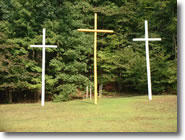
While driving back through northern Maryland, I happened to notice three crosses set up by the side of the road (not unlike the image, except that the middle one was bright white and the ones on either side were brown). I pointed them out to Tina (who, as I've mentioned before, isn't a Christian, and hence is, among many other things, an extremely good source for informed non-Christian reactions to things), and asked her why she thought they were there. She suggested that perhaps they were a roadside memorial to someone who had died nearby. I've seen such things, and for all I know that may well have been part of the motivation for their construction, but it was crystal clear to me that they were meant to symbolize and bring to mind the crosses of Calvary: Jesus in the middle, and a bandit on either side.
Now, here's where it gets speculative (for which I've already apologized). I started wondering what the primary motivation might have been for erecting those crosses in that place. They might well have been intended to call Christians to remembrance of Christ's sacrifice on the cross. But my imagination doubted that that was their primary purpose. My guess was that those crosses' primary reason for standing there by the side of the road was evangelization. My supposition was that someone had erected those crosses primarily so that passing non-Christians, seeing them, would be reminded of the familiar Biblical story of the crucifixion and think, "Oh, yeah. Jesus died for me," and be convicted to make a decision for Christ.
This whole (utterly fabricated) scenario bothered me somewhat, on several levels, but I bet you can guess the main thing that I thought was wrong with this picture, based on my conversation with Tina. If my made-up construct of the reasoning behind those crosses is close to correct, then it's based on an assumption that is largely invalid in today's American society, and is becoming more and more so each year: that any given Biblical story or principle is remotely familiar to the average non-Christian. If I'm right, those crosses were meant to communicate something to folks like Tina, but the message was not being received, because Tina wasn't familiar enough with the story pointed to by the symbols to have a clue what they were trying to convey. And she's a pretty darned informed non-Christian, if for no other reason than that I never shut up.
To the extent that my speculation was remotely on-target, and to the extent that this type of evangelism--proclamation that assumes familiarity with Biblical stories--is practiced exclusively or even primarily by many Christians, I was a bit unsettled by this. I found myself worrying that a lot of effort is going into trying to communicate the good news in a way that it will never be received, as if someone dropped a Russian-language newspaper on my doorstep every morning. It might be full of great reportage, but who cares? I'll ever know.
Anyway, this is the extent to which my imagination got the better to me on a long car ride when it had nothing better to occupy it. I don't have anything against erecting crosses by the roadside, for whatever reason, and I pray that the ministry and mission of the folks who built those particular ones are richly blessed. Amen.
24 July 2005
Babel fish
 This morning, I attended Mars Hill Church, a small, nondenominational, emerging church that gathers at Jammin' Java, a very cool coffeehouse in the middle of Vienna, Virginia. I'm still processing the experience, and may have more to say about it later, but it was one of the most beautiful and God-centered worship services I can recall attending. It was, to use Dr. Len Sweet's acronym for emerging worship gatherings, EPIC: Experiential, Participatory, Image-based, and Connective. They included kids--and did it *well*, making it a good experience for both the kids and the adults. Everyone was very friendly--really! I think I have a lot to learn from these wonderful disciples, and I hope I can keep a conversation going with them.
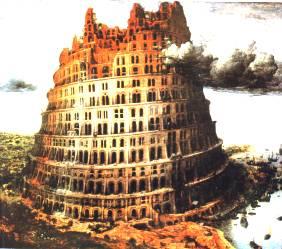
But that's not what I wanted to write about, mainly. I wanted to share just a few of my thoughts on the teaching/discussion topic they chose for today: the Tower of Babel. Three kids (I doubt any of them were 10 yet) read the Biblical story (Genesis 11:1-9), then three other stories connecting it to the myths of other cultures (Greek and African) and to the New Testament story of Pentecost (Acts 2:1-41). Then, after a short preface connecting her own life story to these readings, the leader opened up the floor for discussion. It was a great discussion, and I apologize for not contributing these thoughts at that time, but most of them didn't occur to me until the next section of the service, a free-form worship time in which were were encouraged to pray, write, and/or draw. (So it often goes for us introverts.)
Anyway, this is what I thought about as I sat in silent prayer. (Write during church? Draw during church?? Um, er, sorry, I'm still recovering from the lack of hard pews and kneelers.) ;-)
Recently, I wrote to Mother Blair (formerly the priest in charge of Adult Christian Formation at my church, whom I miss muchly) that, while I don't feel like I'm to a large extent actively "part of the problem" (you know, THE problem--all of our man-made ills), I don't feel like I spend much time being part of the solution, either. Instead, I continuously devote huge helpings of time and energy to being what I called "part of the distraction." Endless amounts of my toil and thought go into accomplishing things that, in God's terms, are pretty much meaningless. I may not be actively increasing the misery in this world, but when it comes right down to it, what does making sure that nothing (I mean nothing!) comes between the American consumer and his or her destined web advertisement have to do with the work that Jesus has given his disciples to do? What does it have to do with being a fisher of men? Sure, I can do my best to make sure that my fellows on the distraction brigade have as pleasant a time as possible getting ads (and, secondarily, news content) in front of people's eyeballs. I can (try to) be an example of Kingdom living to the folks I work with. But it seems like so small a contribution to the reign of God.
Similarly, the Babel folks weren't evil. There's nothing in the biblical story to indicate that they were oppressing anyone (any more than was customary in those days), engaging in violence or terrorism, or even living immorally. What they were doing was investing *huge* amounts of time and resources (human and otherwise) in a big, ambitious project that was completely and utterly beside the point, from God's point of view. They were very industrious! That's good, right? Here in Northern Virginia, we're all really, really industrious! We accomplish tons. We're breathtakingly successful! We juggle marriage, kids, and high-stress, high-workload, high-paying jobs with the greatest of ease (sleep being optional). We have expensive houses, expensive cars, and expensive shrink bills, and it's all good, because just look at our success!
And I'm not saying that all of this activity is bad--by no means! Marriage and parenthood are divine callings, no doubt about it. I pray that those of us with spouses and kids are devoting the time to them that they deserve, and that we deserve to have with them. And a great many of our high-stress, high-paying jobs are absolutely doing lots to improve the lives of our fellow creatures. But I think it's probably worthwhile to reflect (as I'm doing now) on how much of this effort is part of the solution--God's solution--and how much is part of the distraction. Having some experience myself with the whole "divine wake-up call" phenomenon, I feel for the folks at Babel. I hope they found a good path, a godly path, to tread, in community with the fellow speakers of their new languages. And I hope each of us can also find a godly path to walk, with friends, as part of the solution. In Jesus' name we pray, Amen.
23 July 2005
Cost of discipleship
After writing yesterday about Buffy and the cost of discipleship, I opened my daily Bible reading guide this morning and discovered that the passage for today was perhaps the classic Biblical text on that topic: Jeremiah chapter 20. Go read it. Yes, put Buffy on pause and read your Scripture--it's only 18 verses.
Wow, Jeremiah's poetry in that chapter is some raw, powerful stuff, to make an understatement. I've felt that kind of despair, but as a result of chemical-based clinical depression, not as a consequence of living out my call. Inevitably, this "dark night of the soul" will one day occur in the context of my discipleship. I pray that, like Jeremiah (and Buffy), I have the strength and courage to wail and weep and yet to trust and persevere.
Faith is not the absence ot doubt; faith is maintaining commitment in the face of doubt--even overwhelming doubt and despair. God, grant me that kind of faith. Amen.
Wow, Jeremiah's poetry in that chapter is some raw, powerful stuff, to make an understatement. I've felt that kind of despair, but as a result of chemical-based clinical depression, not as a consequence of living out my call. Inevitably, this "dark night of the soul" will one day occur in the context of my discipleship. I pray that, like Jeremiah (and Buffy), I have the strength and courage to wail and weep and yet to trust and persevere.
Faith is not the absence ot doubt; faith is maintaining commitment in the face of doubt--even overwhelming doubt and despair. God, grant me that kind of faith. Amen.
22 July 2005
All I really need to know about discipleship I learned from Buffy
 Buffy the Vampire Slayer. Pop-culture piffle or profound meditation on the life of a disciple in the service of good? If you think it's the former, then you obviously haven't watched it, and here's what you need to do. Get thee post haste to Netflix or Blockbuster or your friend who knows better than you do, and start watching from Season 1
 , Episode 1. I'm not denying that it'll be quite a time commitment to make it through all seven seasons, but you may take as long as you need. Go now. Watch some Buffy. I'll wait.
OK, now I assume I'm preaching to the choir, which suits lazy me just fine. However, if you haven't seen the whole series, please note that BELOW BE SPOILERS. 'Nuff said. So: here's what I learned about discipleship from Buffy.
You don't choose discipleship; you are chosen. None of us gets to decide what gifts we're given, be they natural talents or spiritual gifts. Buffy never wanted to be the vampire slayer. She wanted to be a cheerleader. But she was given, Spidey-style, both great power and great responsibility as the Chosen One. What she did choose--and what she had to keep choosing again and again over the course of seven years--was to accept that responsibility and heed her call. The rest of the Scooby Gang didn't just choose their gifts either--Willow was naturally cut out to be both a computer geek and a witch. And similarly, we choose neither our original call, its shape, or the gifts we're given to respond to it--only whether to answer "here I am" and stay on the path.
Discipleship can be very, very hard. Buffy starts out at the beginning of Season 1 as a relatively carefree teenager who happens to be a superhero. By the later seasons, she is a weary veteran with the weight of a world she's saved again and again on her shoulders. She loses many friends and loves--some die, but others part ways with her because they can't live with who she is. She has to kill her true love to save the world. She sees both herself and her loved ones give in to awful temptations. She herself suffers death (twice), and is forcibly jerked out of heaven by her well-meaning friends. Buffy gets depressed, she despairs, she loses faith. For all the joy in her life--family, friendship, love--her calling is often truly a cross that she must bear. There is often a very steep price associated with discipleship.
Discipleship requires faith and commitment. As I mentioned, Buffy was tempted to abandon her calling many times. And who could blame her? But in the end, she shouldered her burden and soldiered on--largely out of commitment to her friends. And those friends, despite the stress and hurt they often shared, were similarly committed to her. Willow chose to forgo an ivy league education to attend UC Sunnydale and remain a soldier in Buffy's cause. Xander stuck by his friend Willow and redeemed her when she had embraced evil and was about to destroy the world. And none of them ever had any assurance that they would succeed or even survive, apart from their faith in each other and the cause.
Discipleship is a group activity. More than anything, I often think, Buffy is about the cost of discipleship. But I'm wrong. Just watch the show: what's Buffy about? Friendship. It's a show about friendship. No doubt. This is a show about a group of friends who love, support, challenge, hurt, even hate one another sometimes. But there's no doubt that they could not do what they do without each other. "What can't we do if we're together?" they ask in a big ensemble number in the deservedly famous musical episode. And this is how it's always been--Jesus didn't embark on his ministry alone. He did it with his friends--discipleship requires friends.
Discipleship requires laughter. Buffy never makes the mistake of taking itself too seriously. Anya, the ass-kicking, 1000-year-old vengeance demon, is deathly afraid of bunnies. Every single episode contains humor. And why shouldn't it? Every single day on this earth contains humor too, unless we're too busy being serious to notice it. We need funny stuff to keep going, and to keep us humble. Jesus used humor in his parables and teaching: Camel through the eye of the needle? Plank in my eye? Do we often miss this stuff in our quest for Serious Instruction from God's Word?
Discipleship requires forgiveness. In the course of the show, nearly every major character does terrible things which harm themselves, their friends, and others. And so do we. All the time. Buffy and her friends have many opportunities to forgive each other, and they generally do so in the end. And so must we, again and again. Because sin and temptation don't go away just because you've decided to become a committed disciple. Thank God for friends and loved ones with the heart to forgive.
There are probably more discipleship lessons from Buffy, but that's a good start. Now, it wouldn't surprise me if a reader who happens to be a committed Christian is wondering, "OK, so just who is Buffy supposed to be a disciple of, exactly?" And it's true that the show is intentionally vague and equivocal about matters like God and Christianity. In one episode, a character asks Buffy if God exists, and she answers "The jury's still out." Crosses are effective against vampires, but it's never quite clear exactly why that might be. So? Would it have been a better show if it were explicitly Christian and seen by a handful of viewers on the Family Channel? I don't know. I do know that it's full of lessons about discipleship.
So have you seen it yet? No? What are you doing sitting in front of a computer, then? Go to Blockbuster or something. Get yourself some spiritual formation and top-notch entertainment all in one convenient package. And come away energized to be (if this is what you are) a member of Jesus' Scooby Gang.
Ow
 I just mowed over a wasps' nest of some kind. I quickly received a clear impression that the wasps in question were less than pleased. I say "of some kind" because I never saw them. Just felt them, and again, and again...and then I abandoned the mower and ran. Now I have Benadryl cream all over my feet (where I got most of the stings), though they're still throbbing painfully, and I called Tina and told her I'm not going back there, even to retrieve the lawnmower.
This doesn't count as my weekly post. I just wanted to share my pain.
And I'm sorry, wasps. I didn't mean to.
Ow.
16 July 2005
The Boy Who Mentioned Flow: A Fable
 I was very pleased to recently run across an old edition of the little-known fables of the Greek sage Posea, known (to the few who know him) for turning well-known parables on their heads. This can be a valuable way to gain a new perspective, or perhaps a headache. In any event, one tale in particular was very instructive to me personally, and I thought I'd share it with my throngs of Constant Readers.
"The Boy Who Mentioned Flow"
Once there was a small village by a river. Most of the villagers were shepherds, making their living in the hills surrounding the town, but one young lad lived as a fisherman, spending his days by the river and supplying fish to the townsfolk. This boy was well-liked in the village. He was trustworthy and competent and thus earned their trust. He was friendly and thus earned their friendship. He valued harmony, and had harmonious relations with everyone. This was a boy who liked to get along and to see others get along, to "go with the flow," so to speak, and everyone felt that anything left in his hands was bound to go smoothly, with little muss or fuss.
One day, at a town meeting, the townsfolk spent quite some time complaining about another young man, a shepherd, who had recently amused himself by leading the whole village on a wild goose chase to fend off nonexistent wolves who were supposedly threatening the young man's flock. The fisher boy didn't think much of either the prankster or the town's reaction to him--just let it pass and move on, he thought. When they were finished venting, he mentioned casually, "By the way, the flow of the river is up this month. What with all the rain this spring, and the runoff from last winter, the water level's pretty high." The townsfolk greeted this news amiably, because they liked the fisher boy, and, as usual, he spoke as if everything was well and under control. "That's nice!" they said. "Hope it's good for the fish!" The fisher boy actually was a bit concerned about the increased flow, but he felt good that he had alerted the town, and since they didn't seem too worried, he supposed he shouldn't be, either.
A month later, at the town meeting, the villagers were once again stewing about the shepherd boy, who had pulled the same prank again. This time, they were contemplating some kind of reprisal, but the fisher boy suggested that the other lad had probably learned his lesson, and that they should let bygones be bygones. He also mentioned that the river's flow had increased even more, since the rains had continued, and that he'd never seen it so high. "Wow, how about that?" replied the townsfolk. Coming from the fisher boy, this didn't sound like anything to be alarmed about. Remarkable, maybe, but not alarming. The fisher boy himself had been more concerned than ever about it, but, well, he'd done his duty and informed them. Apparently they saw no reason for agitation, and he sure wasn't going to rock the boat.
The next month, the town met in the middle of a thunderstorm of Biblical proportions. Despite the weather, the townsfolk's spirits were up, because that joking shepherd had finally gotten what was coming to him, in their view: real wolves had attacked and, when the cynical villagers refused to come to his aid, had decimated his flock. The fisher boy again mentioned that the river was really, really high now. As they came out of the meeting hall, they were greeted, to their horror, by water rushing through the streets of the village! As a sheep floated by, baaing in terror, and the townsfolk began to run around shouting "Flood, flood!" and desperately attempting to salvage their possessions, the mayor grabbed the fisher boy by the arm. "Fisher boy, you work by the river every day! Didn't you see this coming? Why didn't you cry 'flood' and warn us?"
"But I did warn you!" replied the tearful fisher boy. "I've been warning you for months! You just didn't listen!"
So ends the fable. What I realized, after reading Posea's words, is that I'm the fisher boy! I do this all the time. Case in point: at home, I'm in charge of the financial spreadsheets, mainly because I have more patience for that stuff than Tina does. For a couple of months, I had been mentioning to Tina that we've been going over budget, our "cushion" was disappearing, I'd had to dip into our Christmas Club, etc. Finally, it came to a head and began to impact our get-out-of-debt plan. Tina was pretty angry and wanted to know why I hadn't said anything earlier--didn't I see that this was happening?
Another case in point: at work, we've been running out of space to store the huge files that contain our raw web server logs. For a long time we had disk space to store them all redundantly, but I've been telling my bosses and colleagues for months that we had run out of that space and now had them in only one place, and needed to seriously look at tape backup, etc. Today, we almost lost the only copy of the files for last September. If we had, it would have been fairly disastrous, and I'm completely sure that my colleagues would have felt that I hadn't communicated the fact that we were in a precarious situation, though I could produce an e-mail trail to the contrary.
I don't blame my wife or my co-workers about this one bit. It has to do with the way I unconsciously communicate, relate to others, and react to others' reactions, and now that I've perceived this pattern in myself, I'm hopeful that it won't be so easy for me to unknowingly repeat it. God, help me to discern that there's a time to cry "flood!" and to make sure I'm heard.
Eight-legged friend
 We have an American House Spider (Achaearanea tepidariorum) living in a fine web that she (or he, but let's call her "she") built just inside our bathroom window. Yes, I said "inside;" that's where House Spiders like to live. Her body is about 1 cm long, and each of her legs is about 2 cm if she stretches them out. She's mottled grey/brown, and we know for sure what she is because we looked her up in our Audubon Book of Insects and Spiders and she looks just like her picture.
You may think this is strange, icky, or even alarming, especially since she's hanging right there above our heads when we take a shower, but from our point of view she's more than welcome. Our bathroom doesn't have a fan/vent (and since we rent that's not going to change), so we leave the window cracked much of the time. That's how she got in, and that's how lots of less-welcome buggies get in from time to time. Some of those, she eats, which frankly is A-OK with us, vegetarians or no. She's doing far more good than harm, and we're glad to have her there.
You may wonder if we've never heard of window screens. We have, but again, we're renting, the landlord is uninterested in such things, and our House Spider is both cheaper and more nifty. I wish her good health and a full tummy.
09 July 2005
Brief declaration of intent
OK, I want to try to make a commitment to post to this blog at least weekly. I think that by doing it publicly like this, I might be more likely to stick to it and find the time. On the other hand, the last time I blogged a life change I intended to make (see the post about born again vegetarianism) resulted in a, well, semi-solid commitment. But anywho, I do declare that such is my intent.
More on the Lord's Prayer
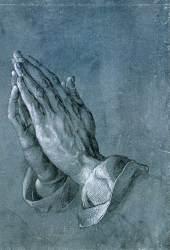 I remember the first prayer my mom taught me when I was a little nipper. It went like this:
Now I lay me down to sleep
I pray the Lord my soul to keep
If I should die before I wake
I pray the Lord my soul to take
I prayed that prayer every night before bed, and I liked talking to God, but I must say that I prayed with a bit of trepidation. I mean, "If I should die before I wake?" Was that a likely occurrence? Why did Mom think it was a good idea that I pray that every night? Did she know something I didn't? I was, like, four years old, and I preferred to consider myself firmly in the "too young to die" category.
Although I prayed that prayer--er--religiously for quite a while, I admit I was rather relieved when Mom taught me another prayer. The second prayer I ever learned was the Lord's Prayer, and this one seemed much safer. I was praying for bread (which I enjoyed), forgiveness (which I sometimes needed), freedom from temptation (I wasn't sure what that was), and deliverance from evil (that might have seemed scary, but I was already starting to run into bullies and the like, and I thought I could really use God's help in staying away from them, not to mention the ghosts in the attic). I didn't really know what the stuff at the beginning about "hallowed" and "kingdom come" was supposed to mean; I think I figured it was praise like the doxology at the end. The Elizabethan language was a bit awkward but kind of neat, and overall this was a comforting prayer that I enjoyed praying, and I think it's safe to say that, as for many of us, it's the single prayer I've prayed most often as my life has unfolded.
So the Lord's Prayer was safe and comforting, and eventually it became familiar and rote as I prayed it again and again, until I think I was incapable of praying it at all--the words just tumbled out without meaning or emotion. It was like the Pledge of Allegiance. (Do people really think making kids say that over and over makes it more meaningful for them, instead of the opposite?) I think that's the way the Lord's Prayer is for many Americans--safe, neutral, something well known to "pray" when praying is called for. I think it's like that for my wife, who isn't a Christian and who usually avoids joining in when prayers or creeds are spoken, but who will say the Lord's Prayer because, I guess, it's a neutral (neutered?) part of the culture; it doesn't really mean anything or imply commitment or faith.
And I can't blame her--like I said, even my first impression of the Lord's Prayer was that it was safe and comforting and unchallenging. But is that the kind of prayer it really is? If you'll bear with me, I'd like to examine it a bit.
Our Father, who art in heaven
The prayer starts right off with one of Jesus' more radical (and, for him, fundamental) teachings: the God who is in heaven, who is Creator and Lord of both heaven and earth, is as near to us and cares about each of us as a parent, abba, our beloved father, "daddy". Now that is comforting, and it does make me feel safe, but it's not neutral or unchallenging. To us, the idea is too familiar, but to many of Jesus' listeners, his referring to the Creator and Judge of all, the Lord of Hosts (i.e., of armies), as "daddy"--and not just his daddy, but our daddy too--was radical indeed. Also note the plural--not "my" Father but "our" Father. The entire prayer is meant as a communal prayer--even when we pray it alone, we pray it with the communion of saints, past and present. And whenever we pray it in fellowship with other Christians, whenever two or more of us are gathered in his name, the One who originally prayed this prayer is there too.
Hallowed be thy name
Thy kingdom come, thy will be done
On earth as it is in heaven
OK, stop and think about this for just a moment. What are we praying for here, really?
In these lines, we pray for nothing short of the utter transformation of the entire world. Is that safe, neutral, and unchallenging? We're praying for the sort of world in which God's name is revered. That's a different sort of world than we have now. We're praying that the Kingdom of God--the Kingdom that Jesus always talked about in parables, the Kingdom in which all are radically welcomed, valued, healed, forgiven, and saved, in which God's will is done (and not just debated)--will come here. Now. On earth as it is in heaven. This is end-of-the-book-of-Revelation, new-heaven-and-new-earth stuff, but we're not praying that God will bring it about "some day"--this entire prayer is about "this day", as is explicit in the next line. This is saving the world, and this is what Jesus came for. I didn't get this until fairly recently, but now, whenever I pray this part of the Lord's prayer, it becomes a recommitment of myself to discipleship, to the work of bringing about this Kingdom on earth as in heaven.
Give us this day our daily bread
So we start by praying what I believe is our ultimate prayer as Christians and followers of the One who came to proclaim that the Kingdom of God is at hand: thy kingdom come. We've recommitted ourselves to helping to bring about that Kingdom. Now, in the rest of the prayer, we ask God for those things that we will need in order to do this work.
We start by asking for our daily bread. What we'll need first of all is freedom from the pressure of the present: we can't do the work of disciples if we don't have the basic necessities that allow us to survive the day--at least, not for long. This part of the prayer is phrased as an expression of trust: give us this day our daily bread--and I trust that tomorrow, you'll do the same, so I'm not going to worry overmuch about that right now; instead, I'll get down to the work you have given me to do. I've also read that it may perhaps be better translated "Give us this day our bread of The Day", explicitly connecting this line of the prayer to the previous lines and the eschatological theme of ultimate worldwide transformation--give us what we need to help Your Day dawn. And you thought it was nothing but a request for food!
And forgive us our trespasses,
as we forgive those who trespass against us
After freedom from the pressures of the present, the next thing we need in order to do our work on behalf of the Kingdom is freedom from the pressures of the past: guilt over our own sins and mistakes, and anger and ill-will toward those who have wronged us. We need to be free of both of these in order to do our work as disciples; both can hold us back from devoting our full selves to the Reign of God. Sometimes we hold on to these things like they're our most prized possessions, so when we pray this part of the Prayer, we would do well to search our hearts: do we really want to be forgiven, and to forgive? Is this as safe and neutral and easy as we like to think?
Lead us not into temptation,
but deliver us from evil
Having become free from the present and the past, the last thing we need in order to be real disciples is freedom from the pressures of the future: fear and anxiety about evil that might befall us, and our tendencies toward temptation and sin which might at any time entrap us and take us off the path. As with forgiveness, we had better stop and think about this when we pray it to Our Father in heaven: do we really want to be free from temptation? In our more honest moments, don't we like temptation, at least a little bit? More than a little bit? Wouldn't we rather stay within the safe, comforting confines of the people we are today than be transformed like this?
For thine is the kingdom,
And the power,
And the glory,
Forever and ever,
Amen.
So we've prayed for nothing less than the radical transformation of the entire world. We've prayed that God will free us from all tyrannies of the present, past, and future that might hinder us from being full, wholehearted, committed participants in helping to bring about that transformation (i.e., we've prayed that we ourselves may be transformed into transformers, or blessed so that we might bless). And now we finish with a powerful song of confidence in the One who alone has the power to bring about all this transformation. The one with the kingdom, and the power, and the glory forever and ever. This is why we can pray this prayer, because of that One and because of our confidence in that One. Through God, even this is possible. Amen!
So, in the end, I think the common idea of the Lord's Prayer as a safe, neutral, meaning-free platitude is rather a colossal misjudgment. This is no empty, comforting prayer, though to pray it should be a major source of comfort (on the original sense of "strength") for a disciple of Jesus.
And, "dangerous" as it might be, I definitely prefer it to worrying about whether I'll die in my sleep. ;-)
Subscribe to:
Posts (Atom)