26 February 2006

The Continuing Conversion of the Church (1)

The first chapter of CCotC is entitled "Mission and Evangelism: the Emergence of the Theological Challenge". In it, Guder recounts:
  • The rise of optimism in the modern age. The wonders of science, technology, democracy, Western culture, and the Christian social gospel, and the progress and spread of all of these, would surely (it seemed) save us from all ills.
  • The gradual disestablishment of Christianity as the "official" religion of Western societies (aka the end of "Christendom"), accompanied by the adaptation of Christian theology to harmonize it with modern rationalism. This lead directly to the polarization of Christian thought into "fundamentalist" and "liberal" extremes.
  • The creation of the categories of "mission" and "evangelism" as programs of the church as Western culture encountered other cultures and sought to bring them the Gospel - along with Western culture itself.
  • The emergence of "mission", as in the missio Dei or "mission of God", as a major topic of theological inquiry, after the terrible atrocities of the 20th century ushered in the failure of modern optimism and the dawn of the postmodern era. If Christian "mission" was not merely the export of glorious Western Christian culture, what was God's mission?
  • The growing awareness of "evangelism" as being, biblically, at the heart of mission, and also at the heart of Christian discipleship itself.
Toward the end of this first chapter, Guder gets to the heart of where he's going with his book (p. 26):
If the Christian community is to carry out its mission of gospel witness, then its evangelization will be directed both to itself as well as to the world into which it is sent. We need to free our language and our thinking from the idea that evangelistic ministry is only directed to nonbelievers. The New Testament is...addressed to believers from beginning to end, and it evangelizes at every turning. Evangelizing churches are churches that are being evangelized. For the sake of its evangelistic vocation, the continuing conversion of the church is essential.
So where does Guder go from here? Tune in next time....

Snake oil

OK, one brief blog post before The Continuing Conversion of the Church. I've been waffling on whether or not I should post on this subject, but it's been on my mind a lot lately, so here goes. My Rector at Holy Comforter, Fr. Rick Lord, put it really well on his blog:

We realize the gentle but persistent work needed to move from a "membership culture" to a "discipleship culture."

This, I think, cuts to the core of the challenge of the institutional church today. But how do we balance necessary "persistence" with loving "gentleness"? Here's a quote from Anglican scholar Eddie Gibbs, via Ross's blog, which puts the matter a little more bluntly:

Eighty percent of those in the church serve no other function than to help the church meet its budget.

One more quote, this time from Shane Claiborne's disturbing book, The Irresistible Revolution. (By the way, I mentioned that I suspected that The Continuing Conversion of the Church might be the one book I've read that every thinking Christian should read. Well, The Irresistible Revolution may be the one book that every feeling Christian should read. It's made me rethink the meaning of Christian commitment. You should read it.)

Anyway, Shane wrote the following (pp. 104-105):

I am the first to say that we need more safe places, especially in the church, where folks can ask tough questions and seek truth together in humility and grace. I long for people to fall in love with God and each other, and I'm a big fan of being radically inclusive, whether that means not turning off transsexuals or folks who drive SUVs. But I also became aware of how delicate that venture can prove to be. The temptation we face is to compromise the cost of discipleship, and in the process, the Christian identity can get lost. We don't want folks to walk away. We're driven by a sincere longing for others to know God's love and grace and to experience Christian community. And yet we can end up merely cheapening the very thing we want folks to experience. This is the "cheap grace" that spiritual writer and fellow revolutionary Dietrich Bonhoeffer called "the most deadly enemy of the church." And he knew all too well the cost of discipleship: after all, it led to his execution in 1945 for his participation in the Protestant resistance against Hitler.

I was discussing this issue with my lovely wife the other day, and, in concert with these diverse other insights, something hit me (and I think Shane was saying this). "Cheap grace", nominal, membership-based Christianity isn't a problem because it creates burnout among the committed core of disciples who are trying to serve the consuming majority (although it does). It's not a problem because is greatly limits the potential work the church can do on behalf of the Kingdom of God (although it does).

It's a problem because, by promoting nominal Christianity as an authentic option, we (the Church) are no better than snake oil-selling hucksters. We're taking people's money and selling them a product that's a complete and utter sham. By letting folks believe that by showing up for worship once a week (or much less) and dropping something in the collection plate, they're getting "Christianity", we are lying to them and cheating them in a most despicable manner. It would be one thing if we were just ignorant, but we know where they can get the real thing. We can't sell it to them, but we can hook them up. And if we fail to do this because we think it would be unloving, or because we're afraid they'll go away and reduce our membership numbers, then we fail very gravely indeed. We fail in faithfulness, and we fail in love. We do need to be gentle, but we must not fail to be persistent in enabling this transformation from membership to discipleship culture. We must not.

So, sorry, I had to get that off my chest. Now I'll see if I can get the CCotC post done before I sleep tonight. :-)

25 February 2006

Sorry for nothing

...that is, the "nothing" that's been showing up on this blog for the last couple of weeks. I usually manage to find time to write something on the weekends, but last weekend was chock full of prayerful discernment and hanging out with homeless folks, and weekdays have been filled with a really busy day job plus lots of church things in the evenings. And helping my lovely wife get ready for the big honkin' hike. That stuff is likely to continue until the end of March. But starting in April I'm gonna be a trail bachelor and will have more time. Until then, unfortunately, expect more "blog fast", as TSK likes to call it. (That's "fast" as in abstinence, not as in quick.)

But nonetheless, I'm going to try my durndest to get the first post on the Darrell Guder's book (The Continuing Conversion of the Church) this weekend. Thanks for your patience. We know that your rude theology shopping options are plentiful, and we thank you for choosing this blog. ;-)

19 February 2006

Thank you

I just wanted to mention how thankful I am that I was blessed to have not one, but two, good friends within the last week care enough about my spiritual formation to talk to me about it and say things that weren't completely easy for them to say. I won't name any names, but Eleanor and Mike know who they are. :-) Thanks, sister; thanks, brother. I may not always follow your advice, but I will always listen, always think and pray deeply about it, and always greatly appreciate your caring and honesty. Please don't ever hesitate to say what you feel called to say to me. I thank God that you do. Same goes for others who have done the same in the past. (A certain former college roomie comes to mind.) Thank you!

Also, a quick update: I apologize to those interested in and waiting for the series on The Continuing Conversion of the Church. It's coming, I promise! I've been pretty durn busy for the last week, and expect to remeain so for a while, so thanks for your patience.

11 February 2006

The Continuing Conversion of the Church (intro)

I recently finished reading Darrell L. Guder's book, The Continuing Conversion of the Church, one of the books in the Gospel and Our Culture series that also includes the classic Missional Church, edited by Guder. I don't think it's an exaggeration for me to say that this has been the most formative single book I've ever read, apart from the Bible and perhaps the World Scripture (which is a topic for another time). Do I think there's one book, apart from the Bible, that every thinking Christian should read? Heck no; everybody's at a different place in her journey. But if I did think in such a one-size-fits-all manner, and I did think there were such a book, this might be that book. At least until I finish Lesslie Newbigin's The Gospel in a Pluralist Society,which I'm reading now. (After that, it's David Bosch's Transforming Mission. Serious stuff, wot?)

So anyway, I think Continuing Conversion is a pretty enormously important book, and since I know it's not going straight to the front of everybody's "to read" queue, I'm going to go ahead and try to give a taste of the book in a series of posts. I don't pretend I'm up to the task of doing it justice, but maybe it'll be helpful to somebody nonetheless.

This book took me a long time to read. There were several reasons for this. First, I was trying to read a whole bunch of other things at the same time, like I always do, and I'm not a particularly fast reader. Second, it's not exactly Harry Potter. Every sentence of this book is packed with profound theological/ecclesiological/missiological meaning, and I really needed to read a little bit, chew on it a lot, then read a little more. Third (and I really only realized this as I was nearing the end), this book was somewhat painful for me to read, because I kept on reading some of the book and thinking, "Yes! Yes, that's it! I need to go and put that into practice!" But in my current context, with the vast bulk of my working time devoted to my secular day job, and with my "big church", Holy Comforter, really only beginning (in my opinion) to grapple with what it means to be a missional church, I kept on feeling this let down feeling: no matter how much I wanted to put this theology into practice, I really couldn't right now. Not much, anyway.

Anyway, I finished the book, and like I said, it's had quite an effect on me. So in this series of posts I'll do what I can to pass a tiny bit of that transformation on to you, gentle reader. In this intro, I'll just try to summarize the overall argument of the book. This may not make too much sense until I unpack it in follow-up posts, so bear with me:

The fundamental identity of the church is that of a people called and commissioned by Christ to be, do, and say his witness. Living that mission requires that these witnesses translate the gospel whenever it engages a new culture. But a hazard of that necessary translation process is that in the process of translation, the gospel will be reduced and diminished. This gospel reductionism has happened repeatedly in Christian history, and today's church is captive to its own gospel reductionism in many ways: some dating from before the dawn of Christendom and the establishment of Christianity in the Roman Empire under Constantine, some from the modern age, and others from present-day cultural compromise. This fundamental identity as Christ's witnesses means that the heart of Christian ministry is evangelization, but the most urgent need for evangelization is the continued conversion of the church itself: an invitation to the church (at every organizational level) to repent of its gospel reductionism and move toward the fullness of the gospel.

Got all that? I'll attempt to make sense of it in follow-up posts. Prayer may be required. :-)

Radical Love: lecture series at the National Cathedral

Check this out, cats and kittens: it's a lecture series (already ongoing) at the Washington National Cathedral called "Radical Love for a World Endangered". Holy cow, what a line-up! I'd love to see Borg, I wouldn't mind seeing Spong and Salzberg/Thurman, and I think N.T. Wright is an absolute can't miss, unless Tina's schedule or something else dictates that I must. I haven't registered for anything yet. Anybody want to head into DC for a little radical love one of those dates?

09 February 2006

Every job I've ever had

OK, there's this meme going around on the blogs of my homies: listing every job one has ever had. I'm game, but I'm not too into the subject, so I'll try to be brief. I'll probably forget things or mix up the order, because I've yet to have a paying job that, in the final analysis, was all that important to me. So here we go:

  • I never had a job before my senior year in high school. I'm surprised my parents didn't encourage/require me to get one, but for some reason they didn't, and I gotta tell ya, I wasn't the kind of kid that was going to seek one out. But once we realized how much it was going to cost to send me to the private college of my choice (Rochester Institute of Technology), it became clear that I must begin earning my keep.
  • My parents found me my first job, summer before college (I actually think I started earlier than that, but I don't remember). I was a janitor at a local diner/ice cream shop owned by a relative of our next-door neighbors. I was a horrible janitor. I was lazy and I ate and drank my boss's wares. This wasn't exactly stealing (maybe), because the previous janitor had told me it was OK, but I never verified this with the boss and I was a pig about it. If he hadn't been a friend of the family, he probably would have fired me, or maybe he just didn't care that I took four hours, a milkshake, three cans of tomato juice, and a root-beer float to do 90 minutes of work. He wasn't paying me by the hour, so who knows?
  • My second job, freshman year in college, was working at Gracie's (aka Grace Watson Dining Hall, the cafeteria at college). Dish line, beverage runner, garbage detail, stuff like that. That job was kind of fun. They had an industrial-strength garbage disposal that could devour a whole grapefruit: groooowwwrvvm!
  • My parents found me my third job, summer after my freshman year. It was traveling around the county cleaning and servicing computers and audio/visual equipment for local schools. That was kind of fun too. One of my co-workers was from Lebanon, a cousin of Kahlil Gibran, and if we were struggling with some piece of equipment and noon was approaching, he would say, "Eet's a piece of sheet. Let's have lunch." That was a good team.
  • My fourth job, sophomore year, was doing office admin work for the Department of Interpreting Services on campus. One of the colleges at RIT is the National Technical Institute for the Deaf, so we had a fairly large group of American Sign Language interpreters on campus and DIS was where they had their offices, and I was was part of the team that provided their office needs. This was fun, though sometimes boring. But when there was nothing to do, they were happy to pay me to play Fool's Errand on the Macs in the lab. I kept on working there during academic quarters the rest of the time I was at RIT. Tina worked there too, which was cool. We were very crafty in keeping the fact that we were engaged a secret. I'm not sure why we thought it was important to do that.
  • My parents found me my fifth job, summer after my sophomore year. This was working for the company my Dad worked for, whose business was servicing airfoil blades for turbine engines. There were many good aspects to this job. I got to sandblast the crud off these blades, whch was fun. I got to polish the blades using these belt sanders called "Baders", and that was fun too. Best of all, sometimes I got to use the Baders to gouge out cracked areas of the blades, which would then be filled in by welders and finally polished back into shape by folks like me. Gouging was lots of fun. On the down side, this place was the land that OSHA forgot. I would go home at the end of the day, stick a Q-Tip in my ear or my nostril, and it would come out pitch black. I seriously suspected I was going to cough up crud and blood and die. This job finally taught me that I should find my own jobs, instead of letting Mom and Dad do it for me.
  • My sixth job was my first "professional" job. RIT has a strong tradition of cooperative education, which is like paid internship, and my first co-op job was for a pharmaceutical company in Rochester. I was doing desktop computer support - installing applications, etc. It wasn't very challenging or interesting, but it was a great team.
  • My seventh job was also a co-op job. This was more challenging. I was working as a real computer programmer for Xerox. They treated us students really well - like we were the future and all. They threw special parties and picnics for us and we had our own newspaper and stuff. And my team was really cool. They treated me like a real team member, not the clueless newbie I was. I learned a lot.
  • I finally graduated, and went looking for my first "permanent" job. For really, really bad reasons, I ended up going back to the pharmaceutical company. Now it was much worse. It was still unchallenging and boring, but now the company was disintegrating. My job description was to do all the work that used to be done by six co-op students. I was only there for five months, and there was layoff after layoff. Morale was abyssmal. The best thing about the job was bonding with my old team, who used to go out for lunch every day and play Rummy to fend off despair. I ran away from this one.
  • After this I worked for a little consulting company (STI) in a temp-to-perm job with EDS, which had recently landed an outsourcing contract for Xerox's entire IT department. So I was working for STI for EDS for Xerox (then later just for EDS for Xerox). I was doing systems programming and administration. It was pretty good - again, I liked my team - but in the end I got fed up with the politics at EDS, which was the company that made Ross Perot a billionaire. It was all about empire building and turf defending, and I got really sick of being told I couldn't discuss a project with folks in this sister department at EDS because my boss was afraid they'd steal the project from us.
  • What lured me away from EDS was another little consulting company, Sam Asher Computing, run by a really tremendous guy named - wait for it - Sam Asher. This is the job where I learned to do anything and everything, because Sam would literally agree to do anything computer-related that anyone would pay him for, and if he didn't have someone who understood the technology, he'd grab whoever was least busy and we'd learn real quick. I worked for everything from tiny five-person companies to Eastman Kodak. Toward the end, Kodak was my full-time client.
  • In the fall of 1998, Sam told me he wanted to pull me off the Kodak contract to work for Frontier Communications, the phone company. Because I was starting to go into my first bout of severe clinical depression, the idea of changing jobs terrified me. Kodak had offered me a permanent position that summer, and I'd turned it down because I loved Sam. Now I went back to them and took the position. Sam was counting on me for the Frontier job (which I worked for exactly one week), and I felt deeply guilty for letting him down. I started my permanent job at Kodak and spent most of my first day hiding in the computer room trying to figure out if I was having a nervous breakdown. I was in the grip of severe clinical depression, and thus began the worst and longest winter of my life. I managed to keep my Kodak job because my bosses were in different buildings and distracted and had no idea that I accomplished almost nothing that winter.
  • Spring came, and I got better. I got better than better - I got manic! I could do anything! I had boundless energy! I have no idea what my co-workers thought of my complete and utter personality reversal, but I remember them staring at me like I'd grown an extra head on more than one occasion. I had many adventures that summer that I won't recount now, but at the end of the summer Tina and I moved to Maryland. Neither of us had jobs. And - oh boy! Mania was turning back into depression.
  • Tina got a job to keep us fed and housed, but right about then was when we realized that when I was manic, I had spent all the money we had and all the money we didn't have. We were now deeply in debt. I had no job, and I was sinking fast. Thank God (!) I finally got an interview with USATODAY.com, they gave me the job for $10,000 more a year than what I asked for (!), and I've been there ever since, over six years. It's definitely been the best job of my life. Interesting, ever-changing technical challenges, wonderful teammates, and, despite many management changes over the years, consistently compassionate managers. It still feels more like an occupation than a vocation, and I'm becoming more and more unhappy with its utter irrevelance to the Kingdom of God, but it was and is a great job.
So that's it. So much for being brief. :-)

07 February 2006

Believe it or not....

OK, this is going to be a long and unusually confessional post, and many of you will think I'm very silly. So be it. You're right.

A couple of weeks ago, I was in a blue funk for really dumb reasons, particularly given that I've got several good friends with real challenges in their lives right now. But for good reason or for poor, I was mildly depressed due to frustration with various realities regarding my wonderful church, Church of the Holy Comforter. And I've become good friends with the folks at another church, Mars Hill Church, and in my little frustrated mind, everything that was "wrong" with Holy Comforter (CHC) was "right" with Mars Hill (MH). So (and this actually goes back a couple of months at least), my mantra has been "I'm not a consumer Christian," and I've been sternly telling myself that I will certainly not jump ship from my wonderful church that I love and which has helped me so much on my journey, especially when it might need me most. And all the while feeling sorry for myself. Poor me.

So last week I came to a question that was kind of like a decision: couldn't this be a both/and scenario? I didn't know. I confessed some of what was going on in my monkey brain to Fr. Rick and Fr. Lou at CHC and then to Deanna, who's on the leadership team at MH. Specifically, I asked Dee if she thought it would be OK if I gave myself permission to consider myself a "real" member of MH (I've been sort of "extended family" for a bunch of months now) and started showing up on Sundays sometimes, contributing financially and in other ways, and participating more in various manners - all without intentionally weakening my commitment to CHC. On Friday, Dee wrote me back, very graciously, and told me that as far as she was concerned, in a church with no formal membership, I was already a member by any meaningful measure, and they'd love to see more of me.

The rest of that Friday, I could be heard whistling the theme from that 80's TV, show, "The Greatest American Hero". Believe it or not, I'm walking on air.... :-)

So this past Sunday was a pretty emotional day for me, for lots of reasons. I got up at 6 AM to drive for the Hypothermia Response emergency shelter program being run by a couple of Fairfax County mission organizations (FACETS and the Lamb Center). The mission of that program is to prevent hypothermia deaths among the homeless population of Fairfax County by providing emergency overflow shelter in local churches when the permanent shelters are full - which is every winter night. The number of nightly guests is approaching seventy. So normally, the job of the driver is to pick guests up at the host church and drive them to the Lamb Center, where they'll be able to stay warm, get lunch, etc. But on Sundays, the Lamb Center is closed. So I had to drop these good people off in a parking lot on Rt. 29 in Fairfax, and watch them walk away from the van with nowhere really to go until evening. Let me tell you, brothers and sisters, that was a hard thing. I cried driving home.

I calmed down a bit by going for a jog, then got dressed up and went to CHC for Mother DeDe's going away reception. She's moving on in her journey and pursuing a doctorate in Christian Ethics, which is wonderful, but it was hard to say goodbye, even though we never got to know each other too well. Then I ushered at the 11 AM service, and it was a good thing I was in the back, because I was getting choked up - again - during Rick+'s sermon. His sermon was on 2 Kings 4:8-37, and to me, the story and Rick's sermon were completely about my friends Mike and Stacy, though I know this was only in my own mind.

After the service, I ran home, changed, wolfed down a slice of cold pizza, and rushed off to a FACETS property to participate with Mars Hill in their monthly "service worship"; in this case, helping clean the apartment of a FACETS client. This was so wonderful for me. I got to spend time talking with and getting to know better these incredible folks from what was now in my mind "my church" while helping somebody out who was so very sweet and happy to have us there. At one point we sent out a small shopping expedition to get some more cleaning supplies, and Dee suggested they also get something nice, like a bouquet of flowers. Well, our hostess was absolutely tickled pink about the flowers. For me, this was the highlight of an emotional rollercoaster of a day, even though there was more good stuff to follow. "Da da da da da, I'm walkin' on air...."

The "good stuff" that followed was an incredibly fun Super Bowl party at the home of Mars Hill's Diana and Paul, hostess and host extraordinaire. Great food and drink, and just a wonderful opportunity to relax and hang out and chat with folks - and a lot of folks from the church were there. And I guess there was some football game going on. I could tell by how worked up Israel was getting. ;-)

Holy cow, what a day. I got home around 11 PM and slept like a dead man for nine hours.

All right, now I need to rewind to the middle of last week. If you've stuck with me this far, you must love me. I said it would be long.

So early last week, I got invited to a CHC Missions meeting scheduled for this coming Monday. Frankly, I immediately dreaded it. It had to do with some of the things I mentioned that frustrated me about CHC, which in my mind were "right" about MH. In this case, what was bugging me was the fact that we tend to do ministry like a business meeting: show up once every few weeks or few months, pray for three minutes, run down an agenda for two hours, pray for three minutes, then "break!" and rush off to the next thing in our busy lives. Very little opportunity for fellowship or shared spiritual practice as a team. So midway through last week, I decided that I wasn't going to silently grumble and dread this. Instead, I'd suggest doing things a little differently. So I volunteered to show up 1/2 hour early and bring food and drink, and invited the rest of the team to come early too for some fellowship time with no agenda. And I also suggested that we spend the first 20 minutes of our "agenda" time in group reflection on a Bible passage - in this case, Luke 10:1-12.

Well, the response was overwhelming positive! Everybody loved the ideas, and most people showed up early and brought food and/or drink. We followed with a spirited and illuminating Bible study, and followed that with an equally spirited discussion of Missions priorities in which consensus was achieved on important matters about three minutes after we had collectively given up. It was a great meeting! "Believe it or not, I'm walkin' on air...."

It taught me two things: 1) never, ever silently grumble, especially about church matters, because you can't tell what the Spirit is up to! And 2) much of my frustration about CHC, like my angst over whether MH would want me to be a "real" member, has to do with my own mental blocks, not God's reality. So God, forgive me for my lack of faith! And thank You for, again and again and again, blessing me to a ridiculous degree. I know humans are pattern-seeking animals with an evolutionary predisposition to connect dots and interpret reality according to their own current assumptions. I'm a theist, and a strong believer in divine providence, so I'm going to look around and see the hand of God. I know this, but nonetheless, it's impossible for me not to see God's hand in bringing me here to Vienna, Virginia, and connecting me to not one, but two, gloriously wonderful communities of faith. Praise God, and thank you, churches. I love you all.

04 February 2006

Friend of Missional

Somebody - I'm not sure who, but it might have been Bartimaeus of The Blind Beggar - has assembled a nice page of "What does 'Missional' mean?" bullet points and invited folks to link to it using the icon you see here. Sure, I'm game, though I'm not sure it makes quite as much sense as "Friend of Emergent" since Emergent is a discreet entity of sorts, but Missional is not. Whatever. It's a nice list (or, actually, set of lists). Check it out.

03 February 2006

You need to read this

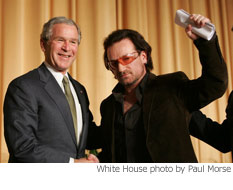
It's Bono's keynote sermon at the National Prayer Breakfast yesterday. Bono, like Jacob Fuller in From Dusk Till Dawn, is one mean mmmm-mmmm servant of God. He puts the Millennium Development Goals clearly in front of the President and Congress, and dares them, from a faith perspective, not to devote another 1% of the federal budget to meeting those goals and extending a hand of partnership to Africa.

And check out this picture:

I love Dylan's commentary on it:
What do you think? I think this photo looks like President Bush was trying to get a photo that said, “I'm best-est friends with Bono,” and Bono, with his straight face, set jaw, downcast eye, and “power to the people” raised text, was saying, “it's about the message ... and if I have to fight you later to try to keep you on that message, I will.”
That's one kick-ass sermon, rock star man. I pray the right folks were paying attention.

02 February 2006

Emerging? Missional?

What do these words mean?

Ask the one and only Tall Skinny Kiwi. (All right, there are probably lots of tall, skinny New Zealanders, but only one who's important. To me.) ;-) His answers are as good as any I've seen, at least without going into much more detail.

01 February 2006

I'm published!

Hey! I'm published! And not just on my own blog, either!

I wrote an article that is now published in the webzine "CrossLeft Matters", Volume 1, Number 1 (January 2006). CrossLeft is "a strategy clearing-house and central hub for grassroots activism among progressive Christians." They're a bit like Sojourners in that they're attempting to organize the progressive Christian voice, in contrast to the (often ultra-) conservative Christian voice articulated so clearly by Christian radio, televangelism, the Christian Coalition, etc.

I wrote the article after reading the first issue of the webzine (Volume 0, Number 1) and coming away a little concerned regarding the tone of some of the rhetoric. I thought the passionate call to action was entirely appropriate, but I thought the metaphor of "war" used to describe progressive Christians' engagement with their conservative sisters and brothers was not appropriate in light of John 13:34-35 and other key Biblical passages. So I wrote this article. And it certainly helped that I was a friend of the Editor-in-Chief. So now I'm published.

Upon re-reading it now, I find myself wishing that I'd inserted the word "some" at the beginning of the phrase "conservative Christians have worked hard to associate Christianity with...." And there are some other things I might reword if I were writing it today instead of three weeks ago. It occurs to me that it's got the potential to piss off a wide spectrum of folks. But oh well, them were my words, and I take responsibility for them. I didn't intend to antagonize anyone, just to say: do speak, do act, but do it in love.

Anyway, feel free to share your reactions, if any, in the comments below.

28 January 2006

Pillar of fire

So last night, I was praying night prayer, or Compline, in my bedroom. (The link is to some short Celtic Complines from the Northumbria Community in England, but I also pray using various versions of the Anglican Book of Common Prayer as well as other prayer books, especially Celtic ones). This is an on-again, off-again habit I've had which I recently resumed following advice from my Discipleship Group leader, Carl. It's been a good thing in my life, so thanks, Carl.

Anyway, it was late at night, and Tina was already asleep, and I lit a stick of incense and a candle (as is my habit) and started to pray Compline. I want to talk a little more about the candle. I had one of those little glass candle holders that's made for a votive candle and is about the size of a small juice glass. It's green. I didn't have any votive candles, so what I put in it was what they call a "tea light", which is one of those little, short, round candles in a little metal cup, about the same diameter as a votive candle but less than an inch tall. I used a regular match from a matchbook to light it, and only after lighting the incense with the same match, so by the time I lit the candle, I came pretty close to burning my fingers. Accordingly, I dropped the match into the little candle glass, where it lit the wick of the tea light in a satisfactory manner.

If you're still reading, I'm surprised. Why in the name of all that's holy am I going into excruciating detail on the lighting of a candle? Well, I'll tell you why. Because somehow, that particular chain of events led to this: right in the middle of a period of silence, while I was trying to meditate, I heard a "Whoosh! Crackle, snap, pop!" I opened my eyes and looked up, and my little tea light candle flame had become a full-on pillar of fire. I'm not kidding. Flames were shooting up more then a foot above the top of the little green glass, then dancing left and right, then subsiding a bit, maybe even sinking below the lip of the glass, then, "Whoosh! Snap, crackle, pop!" and up we go again, twisting and dancing and reaching for the ceiling. This kept up for a good five or ten minutes! I sat there just enraptured at the beauty of it. Then a voice boomed, "I AM WHAT I AM!" No, now I'm kidding. :-)

It occurred to me to wonder whether the glass (which was sitting at eye-level) was going to explode and send shards of itself hurtling into my face, but I decided that to follow that line of thinking would be ungrateful. So I just sat there watching and listening and enjoying it until, several minutes later, it slowly subsided and died, the tea light completely used up.

Now, I don't assign any particular significance, spiritual or otherwise, to this event. But I must say it was pretty freakin' cool!!! And I'm grateful to have experienced it. So I'm going to light another tea light in the same little green glass and pray Compline again tonight before I go to sleep. If I see any winged beasts with four different faces, I'll let you know.

25 January 2006

2 Chronicles 8

Well, after a pleasant romp through the epistles of John and the letter to the Ephesians, my daily Bible study book is back in the books of Chronicles. Today's study, on 2 Chronicles chapter 8, has me raising my eyebrow. The last time I posted on a difficult passage from Chronicles, it was the occasion for quite an invigorating discussion. So, here we go. Let's see what happens.

OK, I assume you've read the chapter by now. It's only 16 verses - no biggie. I don't know what you think of it - pretty boring stuff, perhaps - but my study guide zeroed in on two things: Solomon's sin in subjecting non-Israelites to oppressive slave labor, and Solomon's sin of polygamy.

My reaction to these emphases is: whatever happened to the "plain sense of scripture"? Try as I might, I can't detect the slightest hint of disapproval of either of these things in the Biblical narrative. This chapter is a list of Solomon's great accomplishments. How does one get the idea that these are presented as "sin"? Granted, my commentator is correct (from our modern point of view) in pointing out that this oppressive slavery was contrary to the spirit of the Exodus. But my reading of the text is that this point was lost on the Chronicler. I read it as, "Yeah! Solomon conquered Hamath-zobah! Solomon kept the Amorites and Hittites under his thumb! Go Solomon!" And granted, Solomon's son Rehoboam is portrayed as a fool (which he clearly was) a few chapters later when he says to his people, "You thought Dad was bad? You don't know the meaning of bad!!" But here, I don't read any judgment of Solomon's actions. Nor is there judgment of his polygamy. It's just a fact. Solomon built a country home for his Egyptian wife because somebody (Solomon? His wife? The priests?) was uncomfortable with her pagan proximity to where the Ark of the Covenant had been. Sounds prudent, but it's not judged - or if there is a hint of judgment, it's because of her paganness, not his polygamy.

So my commentator springboards from this to an exhortation to safeguard Biblical morality against the "onslaught on Christian values" in today's culture. But what is Biblical morality? To read a passage like this as condemning things like slavery and polygamy is, it seems to me, to impose our concept of morality on the Bible, not to read and listen to what the Bible says. Now, I'm certainly not arguing that slavery and polygamy are good - that's not my point at all - but I am asking: who and what are we serving when we so blatantly make the Bible say what we want it to say? We all do this - it's unavoidable; we're humans and whether we like it or not we see things through our ego-lenses. But I don't know. Am I crazy, or is this kind of Biblical interpretation at best powerful self-delusion and at worst outright deceit? And either way, how can it possibly help us serve God and others?

Anyway, I give you a topic. Discuss. :-)

22 January 2006

A stake in the sand

Ignore my idle speculations about theodicy. My friend Mike knows what he's talking about. Please go to his blog for wisdom from real life. And while you're there, say a prayer for him and his family. God, please love and comfort them.

19 January 2006

Church model quiz

I like this one! Thanks, Sonja!
You scored as Servant Model. Your model of the church is Servant. The mission of the church is to serve others, to challenge unjust structures, and to live the preferential option for the poor. This model could be complemented by other models that focus more on the unique person of Jesus Christ.

Servant Model


84%

Sacrament model


78%

Mystical Communion Model


67%

Herald Model


61%

Institutional Model


11%

What is your model of the church? [Dulles]
created with QuizFarm.com

17 January 2006

Why are Christians so ignorant?

That's a very good question. I don't know the answer, but I do know that (at the moment) if you type it into Google without surrouding quotes, this blog is the second hit from the top. Hah! This rocks! Does this mean that I'm the second-most-ignorant Christian on the web? :-D

(Many thanks for the anonymous web surfer who clicked through to my blog from that Google search. I wonder if I shed any light on your question?)

14 January 2006

Theodicy and grace

One of the classic problems in theology (and faith in general) has the technical name "theodicy". In a nutshell, here's the problem: if God is so flippin' good and so flippin' powerful, why is there so much innocent suffering? Human free will may partially explain it, but what about the terrible disasters of the year past? The tsunamis, hurricanes and earthquakes don't have anything to do with human free will, unless you subscribe to the somewhat crackpot idea that Adam and Eve's sin (aka "The Fall") screwed up the natural world too. Well, just because it occurred to me, I throw out an equally crackpot idea: what if the creation, the natural world, also has something like free will?

I'm not suggesting that nature is sentient, just that perhaps God is, generally speaking, as hands-off with nature as God is with our own human free will. That is, God is no more likely to prevent Hurricane Katrina than God is to possess the mind of a murderer and force him not to kill. Maybe even for the same reasons, not that I claim to understand them fully.

I don't think this is a new idea, and although it is a conscious acknowledgement of the wisdom of Deists like my friend Jan, I'm definitely not going as far as Deists go in claiming that God never takes an active role in creation. (Jesus is of course the most extreme counterexample to that.) But there is a term for God taking an active role in creation: miracle. Nobody thinks miracles are common. We live in a universe in which the innocent often suffer. If this is a just universe, that justice does not operate using the dynamics of physical or emotional joy and suffering.

I used to believe in karma, but I don't any more. There is cause and effect, but it's not moral. When causes and conditions dictate that something nasty will happen and cause suffering, it usually will cause suffering, regardless of the moral history of those affected. When it doesn't, it's a miracle. It's grace. We're not entitled to miracles, any more than we're entitled to have God step in and take over our wills when we're about to do something stupid or evil. When they happen, we should praise God, but miracles don't happen every day.

I don't know if this is helpful, and I realize I'm presenting a pat, static theory again. But it was on my mind, so I throw it out there.

13 January 2006

Both/and

This post was partly inspired by my friend Israel's post here, and also by a post in a Yahoo Group from my friend P3T3, in which he argued for the relative importance of "the means" over "the ends". And the little picture to the left is of a painting called "Either Or, Both And" by Cynthia Tom, which I've used without her permission because I really like it and she doesn't have any copyright info on her web site. Click it for a bigger version. Cynthia, if you'd like me to remove the image, please let me know.

So here's the situation. In this blog, and in the comment sections of blogs belonging to friends, acquaintances, and strangers, I have a tendency to prattle on about theological topics. Many of you have, no doubt, noted this about me.

Due to certain aspects of my personality (if you choose to call them "defects", I won't argue with you), I also have a tendency to want to figure things out. No, not just that - I tend to want to draw some mental lines and boxes, construct some mental structures that I find appealing, wordsmith some nice language around it, and act like I've figured something out. Because that makes me feel better. Because that satisfies my need to reduce something complex and make it controllable. Because when I can control it, it's not threatening. All this is a particularly dangerous personality trait for someone who's theologically inclined. Because when the thing I'm trying to reduce and control is the gospel, then I'm in the land of some very grave sin indeed.

To balance this, I've been blessed with a group of blogging friends and acquaintances who help to hold me accountable when I take a trip to that dark land. They are frequently quick to point out when I seem to have something a bit too figured out, when my carefully constructed theory is leaving out something important. (Actually, I think we all do this for each other. Also, I've noticed - or I think I have - that when I go really far down this road, my friends tend to signal my complete departure into koo-koo-land by utterly ignoring me. I may be wrong about that, but if I'm not - I get it!) :-)

Anyway, what I wanted to do in this post is to present some "both/ands" that I feel I mustn't ever leave out when I'm talking about God and the gospel and the Church. I'm doing this mainly as a corrective for myself, but also as a road map for my corrective friends, and finally as an invitation to add some more to the list. So here are some items that I think are "both/ands" when thinking and talking about God and the gospel. Conceptual constructs that leave out (or greatly minimize) one side of these or the other are, to my mind, reductionist and incomplete. And I realize that by laying this stuff out so neatly like this, I'm only doing it again. Three years as a Buddhist didn't lead me to let go of my love of neat little well-constructed concepts, and probably nothing will.

now AND later: the Kingdom of God and eternal life, two concepts that were central to Jesus' thought, are both about this present time and place, and about "eschatological" or "end-related" things - both this life and the end of this life; both this time and the end of time.

individual AND community: the individual's personal calling, mission, walk with God, etc. is important, and these things are also important at every level of community.

church AND world: the church of Christ exists to love and serve God's people both inside itself and outside itself.

Truth AND truth: absolute Truth and relative, "customized" truth.

Mission AND mission: both the overall, glorious "Mission of God" and "Mission of the Church" and each person and community's individual missional vocation.

being AND doing AND saying: but chief among these (I would say) is being. Being, doing, and saying witness, love, compassion, etc.

ends AND means: where we're going and how we get there are both important, though on balance I agree with P3T3 that the means are probably more important.

truth AND love: we can't sacrifice either one and also live lives worthy of the calling to which we've been called.

So friends, please add to this list if you want to, and also consider yourselves officially requested to whap me upside the head with the rubber chicken of healthy self-doubt if the stuff I write seems to lean so hard toward one side of those tensions that it leaves the other side out. Thanks in advance!

10 January 2006

Missional Church characteristics

People sometimes ask me, "What does this mean, this 'Missional Church' thing you speak of?" (I'm not kidding; they really do!) More often, I think, they nod politely and wonder briefly what the hell I was talking about.

Larry Chouinard has started a list of bullet-points which are easy and quick to read and may be an aid to understanding:

http://lchouinard.blogspot.com/2006/01/missional-church.html

Thanks to the inimitable TallSkinnyKiwi for the link.